
India drafting agrivoltaics policy targeting 5 GW capacity
The Indian government is developing a policy to boost agrivoltaics adoption, aiming for 5 GW capacity in the coming years. Officials emphasize that solar generation must complement, not replace, agricultural cultivation on suitable cropland.
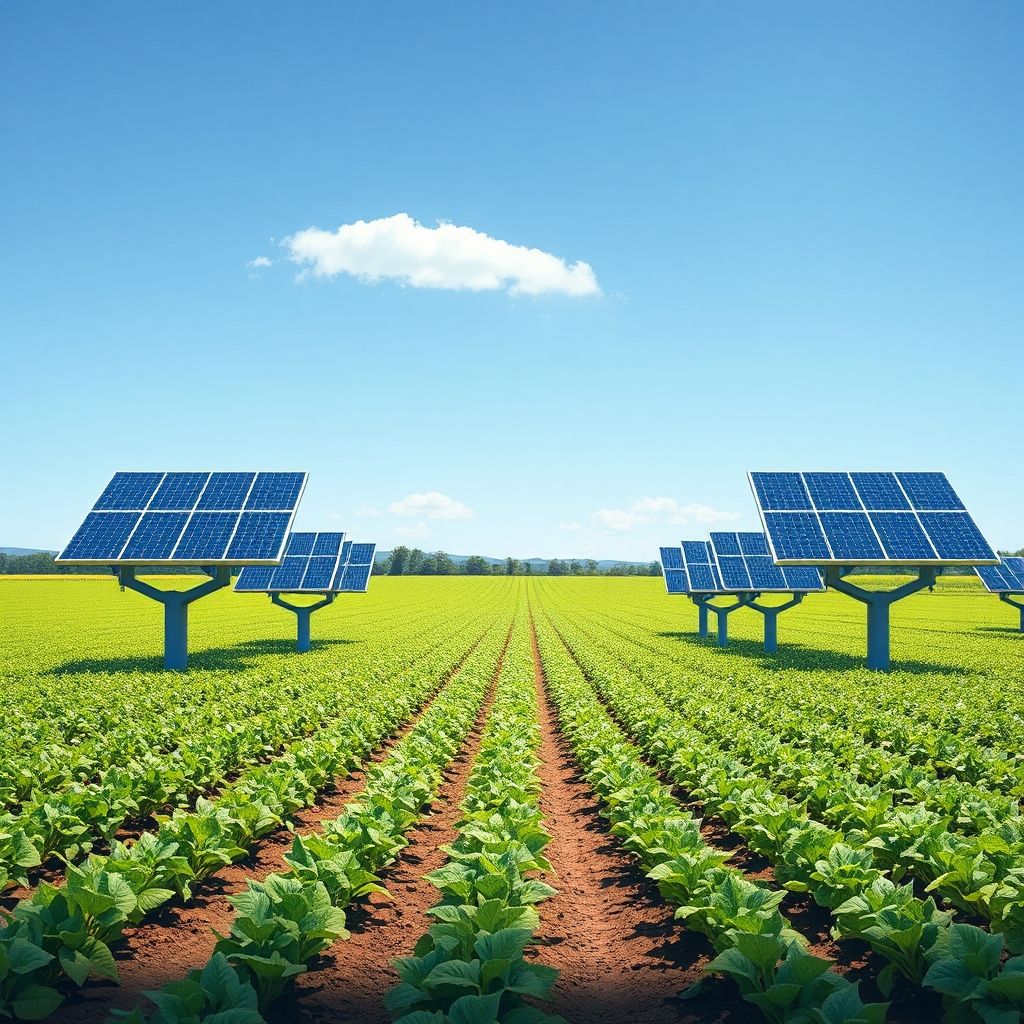
The Indian government is actively developing a policy framework to enhance the adoption of agrivoltaics, a technology that allows for the simultaneous use of land for agricultural cultivation and solar energy generation. Union Minister for New and Renewable Energy Pralhad Joshi highlighted this dual-use capability, while Union Minister of Agriculture and Farmers Welfare Shivraj Singh Chouhan stressed that agrivoltaics models must enable farmers to continue their cultivation activities.
Both spoke at the Agrivoltaics World Conference 2026, “Powering the Global South”, in New Delhi. Joshi said the policy aims to raise farmers’ income, and announced that one of the world’s most ambitious agrivoltaic programmes would be launched under the next phase of PM-KUSUM, aligned with existing agricultural schemes. MNRE Secretary Santosh Kumar Sarangi later told reporters the draft will be put in the public domain for suggestions from states and other stakeholders before it is modified.
Economic and technical parameters
Joshi said 4 acres of land are needed to install 1 MW of solar capacity. Agri-PV plants cost 25 to 30 percent more than conventional ground-mounted solar projects because of the extra infrastructure for elevated tilted structures, he said, and called for scale-up to bring costs down. Agrivoltaic power can be generated at ₹3.20 per unit against ₹2.60 per unit for ground-mounted solar, and Joshi said that gap will have to be closed to make the proposition viable.
On the farm side, Joshi said field studies had indicated potential yield improvements of 10 to 20 percent for certain crops and water savings of around 30 percent under suitable systems. Chouhan called for practical designs that account for panel height, spacing between support structures and the movement of farm machinery, so that farmers can still plough and change crops and cropping patterns.
National potential and distribution
India possesses substantial physical capacity for agrivoltaics, with thirty percent of its 160 million hectares of cropland deemed suitable for the technology. The constraint is the size of holdings: Joshi said 85 percent of India’s farmers are small and marginal and cannot spare land by stopping agricultural activity, and Chouhan said the policy must be designed around their practical needs.
Geographically, the potential is not evenly spread across the subcontinent. Six states—Maharashtra, Rajasthan, Andhra Pradesh, Madhya Pradesh, Karnataka, and Uttar Pradesh—hold fifty percent of India’s total agrivoltaic potential. Globally, installed agrivoltaic capacity has passed 18.4 GW, Joshi said. He pointed to Italy’s 1.7-billion euro funding programme for farmers, developers and research institutions, Japan’s opening of all farmland categories to agrivoltaics with preferential tariffs for small systems, and Germany’s linking of support to continued farming and minimum crop yields.
Domestically, the energy landscape is shifting toward distributed generation. In the previous year, decentralized solar capacity reached 16.3 GW, comprising 7.6 GW from PM-KUSUM initiatives and 8.7 GW from rooftop solar installations. The rooftop figure came largely through the PM Surya Ghar Muft Bijli Yojana, which has crossed 63 lakh beneficiaries.
Policy context and earlier developments
- Luminity reported on 19 October 2026 that the PM-KUSUM 2.0 draft introduces a dedicated agrivoltaics component for small farmers, cooperatives, and panchayats.
- As of that date, the component was not yet active and awaited Cabinet approval.
- The draft proposes elevated panel arrays to allow crops to grow beneath the solar infrastructure.
- Luminity reported on 17 October 2026 that a field study on vertical agrivoltaics in commercial vineyards identified a potential Land Equivalent Ratio (LER) of 1.95.
The pending PM-KUSUM 2.0 framework represents a specific regulatory pathway for integrating solar with agriculture, distinct from general renewable energy targets. It is aimed at small farmers, cooperatives and panchayats, the same group Chouhan said the new policy must serve, and its elevated arrays match the stilt-mounted design an official described for a planned central scheme to help states deploy agrivoltaics.
The concept of a Land Equivalent Ratio (LER) provides a metric for evaluating this dual-use efficiency. An LER greater than one indicates that the combined output of crops and energy from the same area exceeds the output of separate, dedicated uses. The reported LER of 1.95 from the vineyard study suggests a high level of spatial efficiency, although this figure comes from a specific vertical configuration in a commercial viticulture context rather than from Indian field conditions.
What to watch
The immediate next step for the agrivoltaics policy is its release for public and stakeholder consultation. MNRE has not given a date for the draft or for the final policy.
A key point of comparison is the proposed structure of the PM-KUSUM 2.0 scheme. While the central government’s current target is a capacity of 5 GW over the next few years, the proposed PM-KUSUM 2.0 scheme is expected to include a larger, dedicated 10 GW agri-PV component. MNRE Secretary Santosh Kumar Sarangi stated, "We are targeting a capacity of 5 GW over the next few years to begin with," and added: "We will assess the response of the states." How the 5 GW policy target and the 10 GW KUSUM component relate has not been explained. The outcome of the Cabinet approval process for PM-KUSUM 2.0 will also be critical, as it will clarify the financial support available to cooperatives and panchayats.
Germany is also involved on the research side: German Ambassador to India and Bhutan Jasper Wieck promised support for joint research at pilot agrivoltaic sites, to “test how agriculture and solar power generation can be combined economically and sustainably on the same land”.
Source: ETEnergyWorld Renewables. This article is an original Luminity report based on the linked source.