
T&E analysis: Franco-German deal risks 90% of EU battery production
Transport & Environment analysis indicates that a proposed Franco-German automotive agreement could cause nearly 90% of planned European battery cell production to shift abroad. The deal’s limited local content requirements fall short of the stricter standards needed to secure the continent’s battery supply chain.
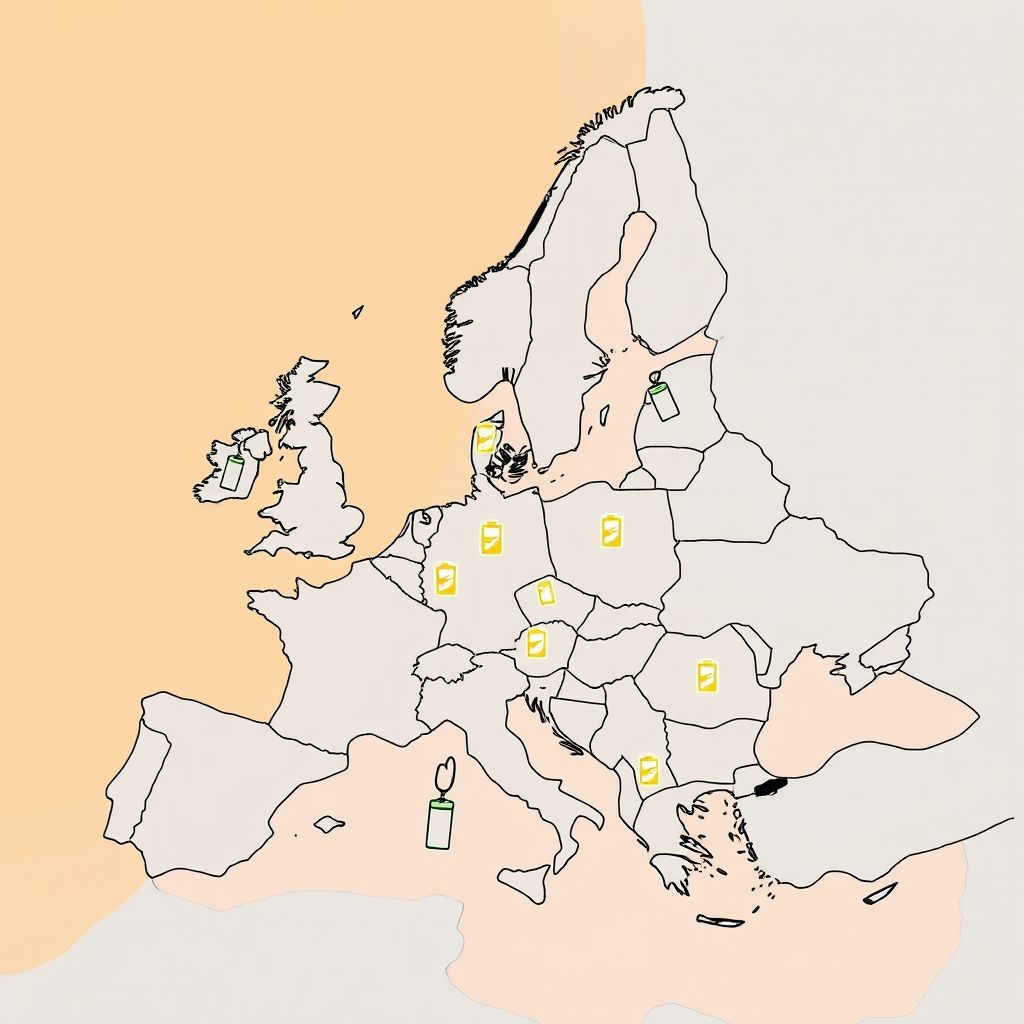
Transport & Environment (T&E) analysis indicates that the recent Franco-German automotive agreement puts a substantial portion of the EU’s 2030 battery manufacturing targets at risk. The study estimates that 100 GWh of cell production and 250 GWh of cathode capacity could shift to non-EU locations.
The volume of at-risk production is significant in practical terms, equivalent to 1.5 million battery packs.
Deal Mechanics
Under the terms of the pact, eligible vehicles must incorporate EU-manufactured cells, starting at a 10% threshold in 2028 and 2029. This share increases to 20% for the 2030 and 2031 model years, followed by a substantial leap to 70% beginning in 2032. At present, more than 50% of the cells used in EVs sold inside the EU are already made on the continent. Franziska Grüning, who serves as Raw Materials Officer at T&E, commented: “The Franco-German deal is a disaster for Europe’s battery industry.”
Demand Impact
| Metric | EU Parliament Proposals | Franco-German Deal (2030) |
|---|---|---|
| Cell Demand Impact | -247 GWh (2027–2032) | Secures 0.9 million EVs |
| EU-made EV Volume | -3.7 million (2027–2032) | 4.6 million (Made-in-EU IAA) |
While weakened emission rules would eliminate millions of domestic EV sales and associated battery capacity, the deal locks in production for a specific, smaller cohort of vehicles.
Supply Chain Risks
- 100 GWh of cell demand and 1.5 million electric cars face potential leakage in 2030.
- 250 GWh of Cathode Active Material (CAM) demand is at risk of shifting to non-EU locations in 2030.
- Under a strict Made-in-EU scope, CAM demand would increase by 323 GWh by 2032.
- Total EU-made CAM would reach 407 GWh, securing 94% of expected supply under that strict scope.
- The future of the Lyten, PowerCo Salzgitter, and Verkor Dunkirk factories could be jeopardised.
CAM refers to the key chemical component in battery cathodes, which is essential for energy storage capacity.
Specific Project and Regulatory Details
The study notes that most EU production expected by 2030 originates from plants that have not yet entered production. Regarding the Industrial Accelerator Act (IAA), the analysis states that a strict Made-in-EU scope, or at most a narrow list of trusted partners including the EU27, EEA, and UK, is required to prevent leakage. T&E argues that CAM producers need large, stable contracts with cell makers and carmakers before they can ramp up, with CAM requirements becoming reachable by 2030 under a strict scope.
What to watch
T&E urges the EU to reject the Franco-German agreement and maintain the European Commission’s original proposal timelines. The immediate question is whether Brussels will abandon these plans or attempt to renegotiate the terms. Without a finalized Industrial Accelerator Act, the bloc lacks the legislative framework to enforce stricter regional content rules.
Source: CleanTechnica. This article is an original Luminity report based on the linked source.