
MicroQuanta reports 23.9% efficiency for 19.48 cm² perovskite mini-module
MicroQuanta Semiconductor achieved a certified 23.9% steady-state efficiency for a 19.48 cm² perovskite mini-module, setting a new world record at the module level. The team utilized a cooling technique to slow crystallization, significantly reducing efficiency loss during scale-up compared to control modules.
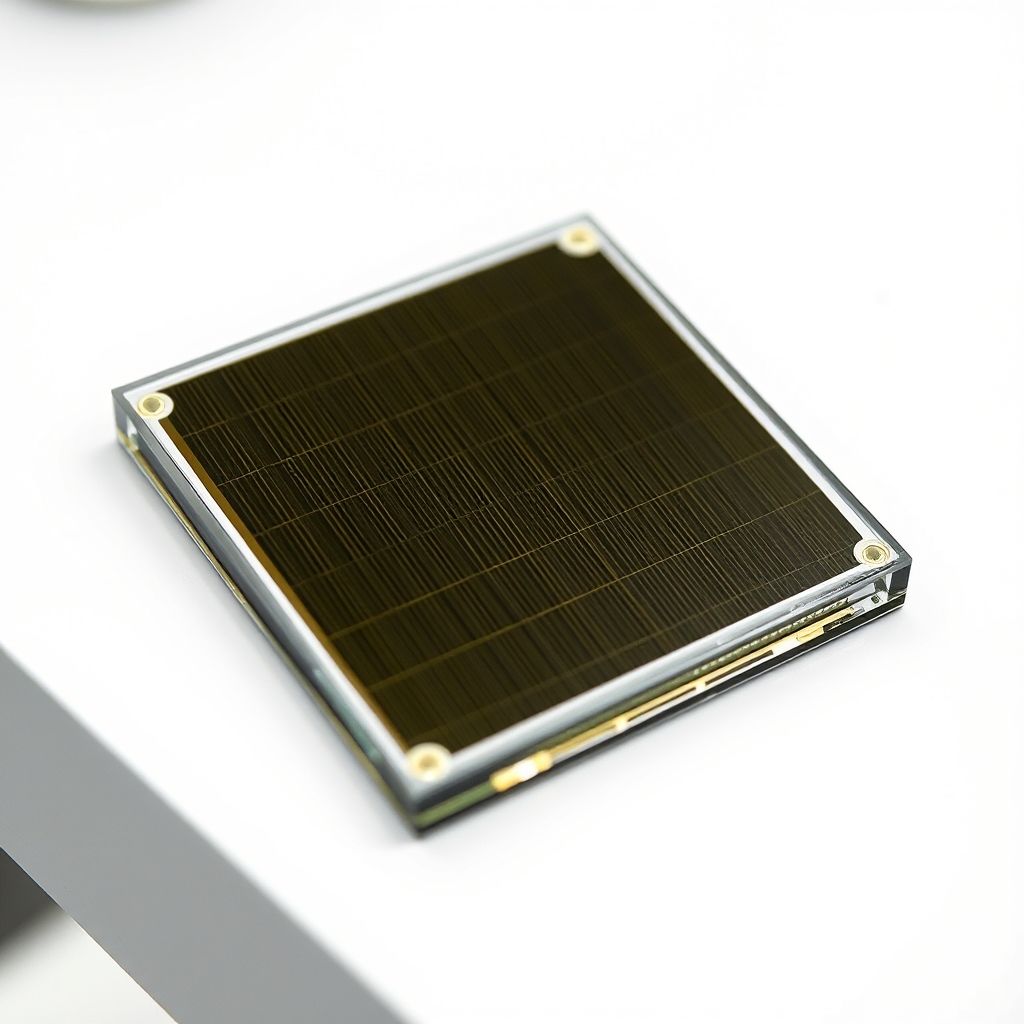
According to MicroQuanta Semiconductor, its research group has secured a stable efficiency rating of 23.9% for a 19.48 cm² perovskite mini-module. This achievement marks a new global benchmark at the module scale and has been verified by the National PV Industry Measurement and Testing Center (NPVM), an entity within China’s Fujian Metrology Institute.
Scaling Challenges and Solutions
- Cooling Technique: To decelerate crystallization, the researchers applied a cooling step to the wet perovskite precursor film prior to vacuum processing, employing a 15-second interval at 0–10°C followed by two minutes of vacuum-flashing.
- Efficiency Loss Factor: The reduction in fill factor emerged as the primary driver behind the efficiency decline observed when expanding from small cells to module dimensions.
- Commercial Product: At The smarter E Europe 2026, MicroQuanta unveiled the MQ-α² series tandem module, which delivers 26% efficiency with power outputs spanning from 65 W to 165 W.
Dongchen Lan, the corresponding author, noted that this method tackles a significant hurdle in advancing next-generation solar technologies toward practical application.
Device Architecture and Performance Metrics
The 19.48 cm² mini-module comprises eight subcells connected in series using laser scribing. Its stack includes a glass substrate, indium tin oxide (ITO), NiOₓ, 3PATAT-C3, a FA₀.₉₅Cs₀.₀₅PbI₃ absorber layer, EDAI₂ passivation, C₆₀, BCP, and a silver electrode.
| Metric | Value |
|---|---|
| Steady-state efficiency | 23.9% |
| Fill factor | 83.3% |
| Geometric fill factor | 97% |
Durability and Scientific Validation
To tackle the stability issues typical of perovskite modules, where a drop in fill factor is the main driver of efficiency decline during aging, the research team conducted specific tests. In these trials, the cooled modules showed a reduction in efficiency due to this falling fill factor that was less than one-third the magnitude seen in the control modules.
Published in Nature Communications with the title "Retarding efficiency loss upon scaling in perovskite photovoltaics as fill factor becomes the bottleneck," the study was a joint effort involving Zhejiang University, China Three Gorges Renewable, the Zhejiang Provincial Key Laboratory, and the Australian Centre for Advanced Photovoltaics.
Production Roadmap and Earlier Milestones
MicroQuanta is constructing a gigawatt-scale perovskite manufacturing facility in Quzhou, Zhejiang province, intended to produce large-area modules with a size of 2.88 m². Before setting the current record, the firm disclosed in January 2025 that it had secured a certified efficiency of 21.86% for an 810 cm² perovskite solar module. The MQ-α² series tandem modules, unveiled at The smarter E Europe 2026 in Munich, offer customizable colors and finishes tailored for building-integrated photovoltaics.
Analytical Methodology and Operational Decay
Researchers applied Shapley value analysis to measure how open-circuit voltage, short-circuit current density, and fill factor contribute to observed efficiency drops, calculating average parameter impacts across every potential substitution sequence. By using this statistical method, they identified fill factor as the primary source of loss once current reductions from inactive zones formed by laser scribing were factored in. Dongchen Lan, the corresponding author, stressed that this world record was set at the module level instead of with a tiny lab cell, tackling a major hurdle in translating advanced solar technologies into real-world applications. The team determined that maintaining fill factor serves as a cohesive optimization goal, observing that the resulting benefit persists across different device sizes and throughout operational life, which highlights a common parameter-level trend linking scale-up losses with operational degradation.
What to watch
MicroQuanta targets a 20% efficiency level for these planned large-area modules, paired with a projected 25-year lifespan.
Source: pv magazine. This article is an original Luminity report based on the linked source.