
Solar Grazing Census Records 113,000 Sheep Across 129,000 Acres
A 2024 census by ASGA and NREL found over 113,000 sheep grazing on 129,000 acres of solar land. Nexamp and other developers are expanding livestock programs to manage vegetation and support operations.
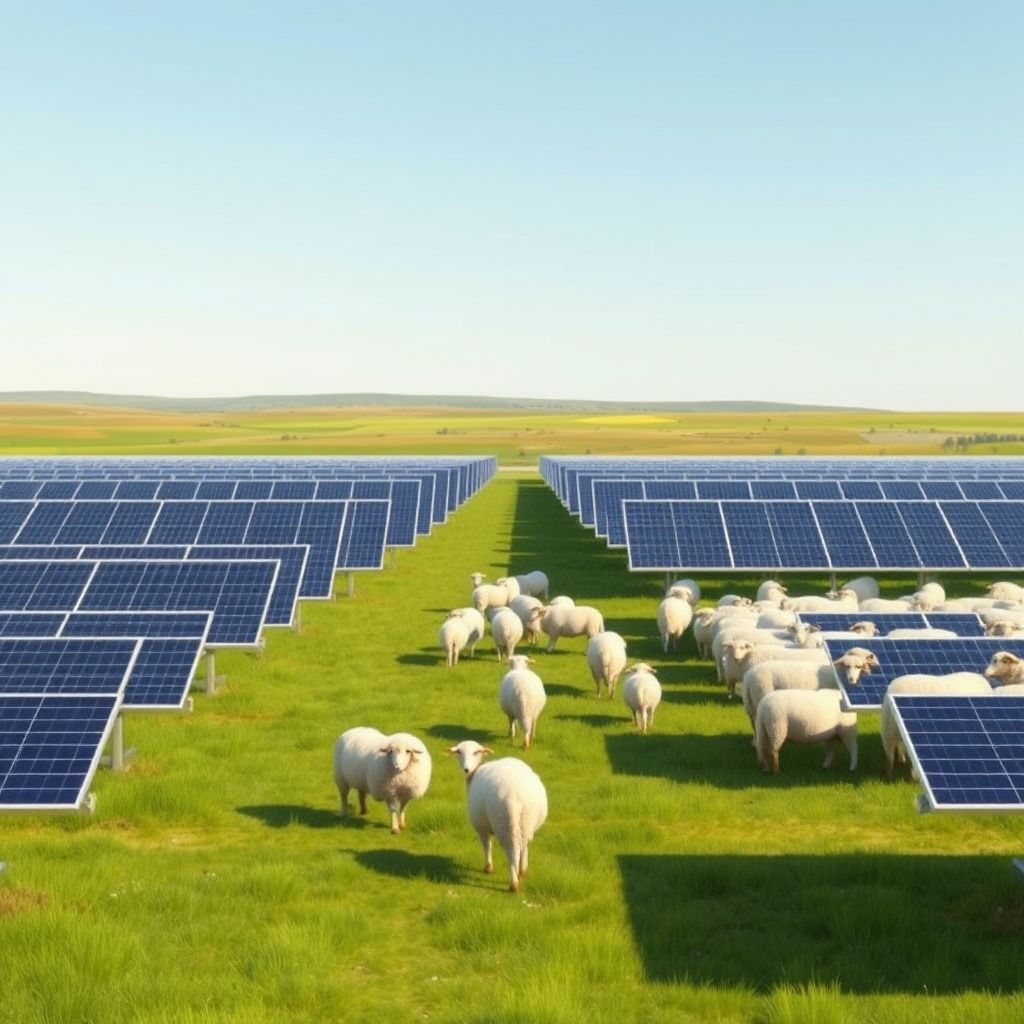
The American Solar Grazing Association (ASGA) and the National Renewable Energy Laboratory (NREL) recently released their 2024 census data on solar grazing, a practice that utilizes livestock to manage vegetation at solar facilities. According to the report, the survey recorded over 113,000 sheep across 129,000 acres.
This data highlights the growing integration of agricultural activities with renewable energy infrastructure. By employing sheep for vegetation management, solar sites can maintain ground cover while generating power. The census serves as a key indicator of how these dual-use strategies are being implemented across the country.
The findings come from the joint effort by ASGA and NREL, which track the scale of solar grazing operations. These figures provide a snapshot of current adoption levels, offering insights into the practical application of integrating livestock with solar energy projects. The report underscores the operational reality of managing land for both energy production and agricultural purposes.
Industry Scale and History
While the national census captures the breadth of solar grazing, specific operational histories reveal how individual firms have scaled these programs over time. Nexamp, which started its business in 2018, provides a concrete example of this trajectory. The company began its distinct grazing program in 2019, marking the initial rollout of livestock management at its locations. By the time of the recent census, Nexamp had expanded its operations to include livestock grazing at 89 sites spread across five states. This geographic distribution indicates a multi-state implementation strategy rather than a single-site pilot.
The scale of Nexamp’s involvement is substantial in the context of dual-use land management. Its sites covered almost 2,000 acres under grazing management. This footprint represents a significant portion of the total acreage recorded in the broader national data. For operators, establishing a grazing program involves coordinating with local ranchers and managing the logistics of moving animals between panels. The progression from a single-year start to a multi-state, nearly 2,000-acre operation illustrates the practical viability of integrating agriculture into solar facility operations. Such expansion often depends on consistent vegetation growth and the availability of suitable livestock management partners in the relevant regions. The data points from Nexamp highlight how early adopters have built out their programs to cover diverse geographic areas, contributing to the overall industry metrics.
Pilot Programs and Partnerships
- J&R Pierce Family Farm piloted cattle grazing at two New York sites.
- Five cattle participated in the New York pilot.
- ReVision Energy partnered with Black Earth Grazing starting in 2024.
- Black Earth Grazing manages 11 ReVision community solar sites.
These early experiments illustrate how larger operators are testing different livestock species and partnership models beyond the dominant sheep-based approach. J&R Pierce Family Farm introduced cattle to the equation, running a pilot with just five animals across two locations in New York. Using cattle instead of sheep changes the vegetation management dynamics, as larger animals graze differently and may require different fencing or handling infrastructure. This small-scale test allows the farm and project owners to assess practical feasibility before any wider rollout.
Meanwhile, ReVision Energy formalized a broader partnership with Black Earth Grazing in 2024. Under this agreement, Black Earth Grazing takes on the management of 11 community solar sites. Community solar projects often serve residential or small commercial customers who cannot install their own panels, so integrating grazing here adds an agricultural layer to a distributed energy model. Such partnerships shift the operational burden of vegetation control to specialized partners, allowing energy developers to focus on grid compliance and energy output. This division of labor is becoming a standard way to handle the ongoing maintenance needs of ground-mounted solar arrays.
Operational Benefits and Collaboration
Integrating livestock into solar facility operations creates a complex dynamic for the teams responsible for daily maintenance. While the census data captures the sheer volume of sheep and acres, the on-ground reality involves intricate coordination between energy operators and agricultural partners. The challenge lies in translating this physical presence into measurable operational gains. As one industry representative noted, it is difficult to quantify on paper what being on site means to the operations and maintenance team. This difficulty stems from the intangible benefits of having animals manage vegetation, which often reduces the frequency of mechanical mowing and associated fuel costs, yet these savings are rarely isolated in standard reporting.
Building a successful partnership requires a period of mutual adjustment. For many operators, the transition from traditional vegetation management to grazing is not immediate. One company recalled beginning its grazing program in 2019 with just one site, a modest start that allowed both parties to learn the specific rhythms of the land. This gradual approach helps mitigate risks related to animal behavior, fence integrity, and panel cleanliness. The process involves both sides educating each other on their respective priorities and constraints. According to that representative, once both parties do a little work of educating each other, the partnership can serve both interests. This collaborative model transforms the solar array from a static energy asset into a dynamic agricultural environment, where the O&M team and the grazing partner share responsibility for site health. Such relationships often evolve over time, with initial protocols refined through shared experience. The success of these collaborations depends on clear communication and a shared understanding of how livestock movement impacts energy production and grid reliability.
What to watch
The next phase of solar grazing depends on scaling these pilot partnerships into standard operational practice. Watch for how the 2024 collaboration between ReVision Energy and Black Earth Grazing evolves, particularly as management expands across the 11 community solar sites. This arrangement serves as a critical test case for distributed energy models, where integrating livestock must align with the specific needs of residential and small commercial customers who rely on these projects for power. Success here hinges on whether specialized partners can maintain grid compliance and energy output while handling vegetation, a division of labor that determines if this model remains a niche experiment or becomes the baseline for ground-mounted arrays.
The industry is moving beyond sheep-centric operations. The cattle pilot by J&R Pierce Family Farm in New York introduces different vegetation management dynamics, requiring distinct fencing and handling infrastructure. Readers should look for evidence of whether these larger animals prove viable for broader adoption or remain limited to specific site conditions. As operators like Nexamp continue to refine their multi-state logistics, the focus shifts from initial deployment to long-term sustainability. The key question is whether the intangible operational benefits, such as reduced mechanical mowing frequency, can be consistently quantified to justify the coordination costs. Ultimately, the viability of this dual-use land management strategy rests on the ability of energy developers and agricultural partners to maintain clear communication and shared responsibility for site health, ensuring that the agricultural layer supports rather than disrupts the primary energy function.
Source: pv magazine USA. This article is an original Luminity report based on the linked source.