
Industry split over whether data centres can use existing renewable credits
Australian energy bodies disagree on if data centres should be allowed to use existing renewable energy certificates to meet demand. The debate centres on balancing rapid data centre construction against the longer lead times for new solar and wind farms.
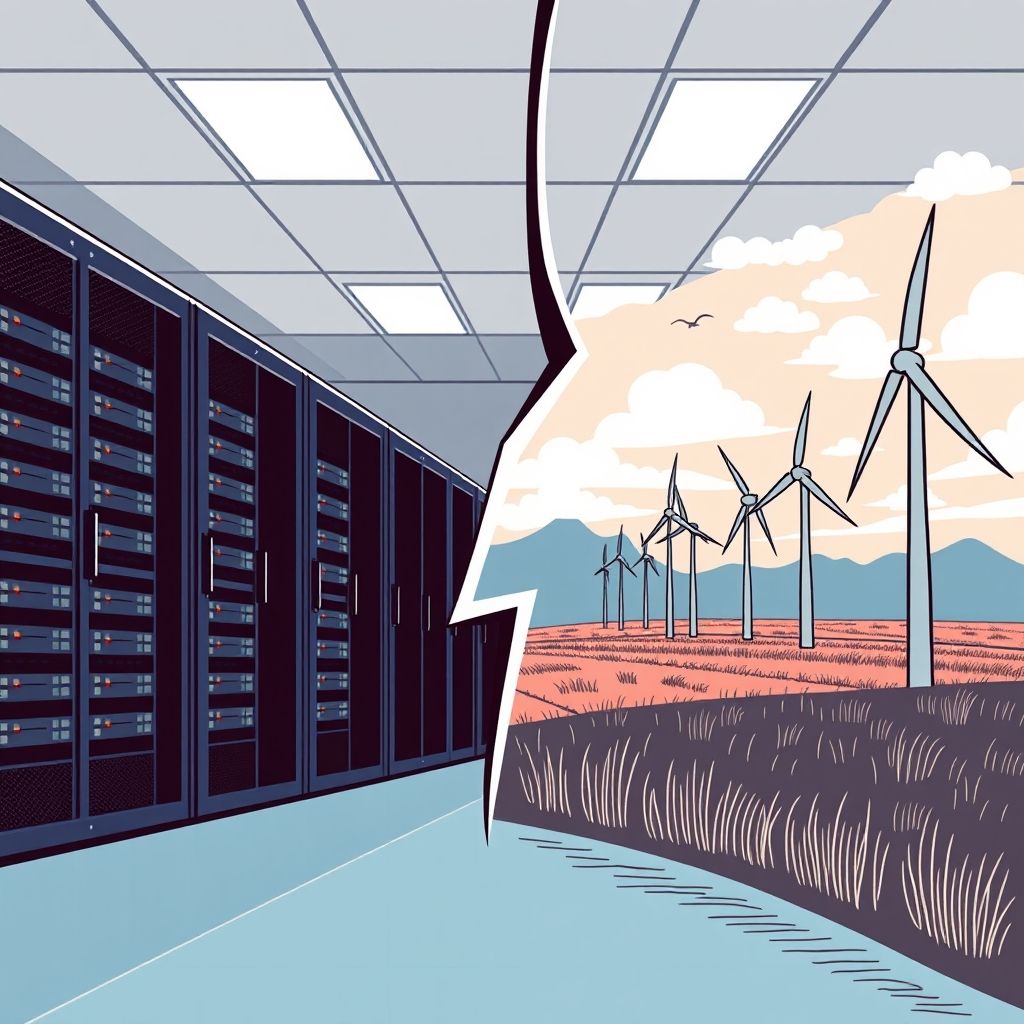
The renewable energy industry is split over how data centres should procure clean power, with disagreement centering on the use of existing versus new solar and wind farm generator credits.
According to a forecast by the Australian Energy Market Operator, data centre power usage is expected to increase seven-fold, reaching 34 terawatt-hours over the next decade.
The Core Disagreement
The Clean Energy Council and the Clean Energy Investor Group back the use of existing Renewable Energy Generation Certificates, or REGOs, to meet data centre power needs. In direct opposition, the Smart Energy Council rejects this approach, insisting that 100% of the required power must come from new renewable generation assets.
Tristan Edis, CEO of Green Energy Markets, argues that preventing emissions and price increases from rising data centre demand requires adding new renewable supply. He warns that regulators must avoid creating a loophole that allows data centres to escape the requirement to bring on new capacity.
Clare Savage, chair of the Australian Energy Market Commission, clarified that the advice regarding the use of existing REGOs was merely put forward for consideration. Meanwhile, the Smart Energy Council has added a specific technical demand to its position, requiring that firming supply be sourced from storage rather than gas.
Lead Time Mismatch
The Clean Energy Investor Group (CEIG) highlights a structural timing gap between data centre construction and renewable energy deployment. Citing 2017 data from the Clean Energy Council, CEIG notes that data centres have an average build time of about a year. In contrast, renewable energy projects require significantly longer lead times to reach operational status.
| Project Type | Time from Financial Close to Commissioning |
|---|---|
| Data Centre | ~12 months |
| Solar | 21 months |
| Large Battery | 23 months |
| Wind | 30 months |
The Smart Energy Council (SEC) maintains that 100% of data centre demand must be matched with new generation, verified through Renewable Energy Generation Certificates. The industry has not yet determined the duration of any transition period that would accommodate this lag.
Proposed Transition Windows
- The Australian Energy Market Commission (AEMC) recommended that data centres use existing Renewable Energy Generation Certificates (REGOs) as a temporary arrangement during their initial year(s) of operation.
- The Clean Energy Investor Group (CEIG) proposes limiting the use of existing REGOs to a transition window of three to five years.
- The Clean Energy Council (CEC) supports a review after two years for any transition glide path.
- New South Wales suggested a four-year transition glide path.
- Ireland offers up to six years for a transition glide path.
Regulatory Context and Political Tensions
The debate unfolds as the Albanese government and state counterparts attempt to harness data centre productivity without straining the grid or inflating power prices. While federal ministers, including Chris Bowen, assert that clean energy is prioritised, Coalition-led Queensland and the Northern Territory, alongside Labor-led South Australia, have indicated that coal and gas will play important roles in meeting anticipated demand.
The Australian Energy Market Operator’s 2026 Electricity Statement of Opportunities, currently being updated due to delays in the Snowy 2.0 pumped hydro project, underpins these forecasts. The Clean Energy Council, which includes data centre developer AirTrunk among its members, argues that new demand should be matched by equivalent additional renewable supply at or around the time of final investment decisions. A CEC spokesperson stated the objective is to crowd in additional renewable capacity quickly to limit short-term price pressure, emphasising that the focus should be on the period between a data centre’s operation and its contracted supply coming online, rather than setting an arbitrary number of years.
The Clean Energy Investor Group’s submission to the Senate committee examining artificial intelligence and data centres supports a bridging mechanism requiring the surrender of large-scale generation certificates or REGOs from existing projects, excluding below-baseline generators. The group argues this provides existing assets with a revenue boost, helping investors recycle capital into new generation projects.
What to watch
The Smart Energy Council expects the new market architecture, ESEM, to be in place from 2030.
Source: RenewEconomy. This article is an original Luminity report based on the linked source.