
US solar module waste to hit 820,000 mt by 2050 per IEA
The IEA projects US end-of-life crystalline silicon modules will reach 820,000 metric tons by 2050, driving a global recycled materials market valued at $80 billion. New facilities in Texas, Florida, and Nevada aim to recover high-value materials like silver and silicon from this growing waste stream.
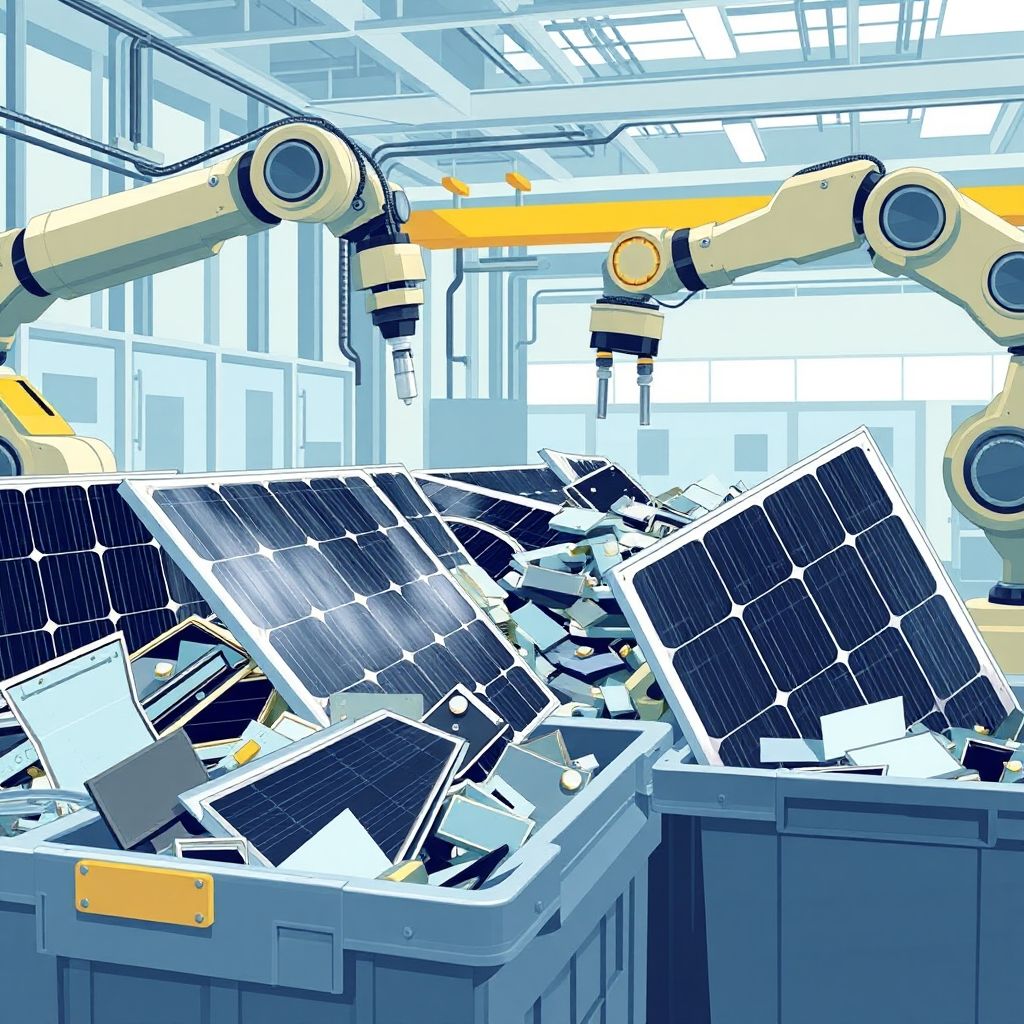
The International Energy Agency (IEA) estimates that the volume of end-of-life crystalline silicon solar modules in the United States will reach 87,000 metric tons by 2030. This figure is projected to grow substantially, with the IEA anticipating that waste volumes will hit 820,000 metric tons by 2050.
Rystad Energy estimates that the global value of recycled solar materials will reach $2.7 billion by 2030.
Market Valuation and Material Composition
Rystad Energy projects that the global value of recycled solar materials will reach $80 billion by 2050. Within North America, the firm estimates the value of end-of-life modules will hit $1.4 billion in 2037.
| Material | Weight Percentage |
|---|---|
| Glass | 70% – 76% |
| Aluminum Frame | 8% – 13% |
Silver Economics and Regulatory Context
Silver accounts for 60% of the cost of a solar cell and 10% of the total module price. This high input cost drives manufacturers to reduce usage, with the IEA reporting that consumption fell from 16 mg/W in 2020 to 10 mg/W in 2024.
In November 2025, the United States added silver to its Critical Minerals List.
Emerging Recovery Technologies
Three distinct facility projects are currently advancing module recycling capabilities in the United States, each employing different processing methods and operational timelines:
- WRS: The Dallas, Texas facility is scheduled to open in the third quarter of 2027. The company states it can recover up to 96% of silver, copper, silicon, aluminum, and glass. WRS CEO Adam Saghei noted that the industry has historically operated on a "1.0 system," adding that the new process functions on "a very small footprint with regenerative solvents."
- OnePlanet Solar: The Florida plant has a processing capacity of 480,000 modules, or 19,000 tons, per year. The PRISM process, unveiled in August 2026, produces 99% pure glass and 95% pure silicon with 1% silver. Recycling operations under this process are set to begin in 2027.
- Comstock Metals: The Nevada facility was commissioned in August 2026 with a rated capacity of 100,000 tons per year. Current output stands at 25% of that rated capacity. Comstock CFO Judd Merrill stated that company strategy involves retaining metal-rich material for proprietary recovery, though no timeline was provided for the pilot-scale metals recovery operation.
Operational Status and Process Specifications
Since the beginning of 2024, OnePlanet Solar’s commercial demonstration facility in Florida has been in active operation. The firm indicates that every unit of material produced at this site has been purchased and utilized domestically within the U.S. The company’s PRISM method, which stands for Photovoltaic Recycling through Integrated Systems and Mechanics, produces glass with 99% purity prior to any grinding or size-reduction stages, applicable to both single-side and bifacial panels. Looking ahead, OnePlanet aims to purify its own metallurgical-grade silicon while also extracting silver as a secondary commercial output.
In Nevada, Comstock Metals is scaling up production at its Silver Springs site to reach 25% of its maximum annual capacity of 100,000 tons. At this location, the company is deploying a unique technique intended to fully break down adhesives, encapsulants, and plastics prior to the sorting and separation of the remaining panel parts for further treatment.
In September, We Recycle Solar (WRS) revealed its intention to launch what it describes as “the nation’s first end-to-end critical materials recovery facility for retired solar panels” on a 10-acre plot in Dallas, Texas. Adam Saghei, WRS’s CEO, noted that the resulting glass has impurity levels below 10 parts per million, characterizing it as “essentially pure enough for you to drink out of.”
In the past, PV recyclers typically isolated glass and frames while shredding laminated sections, frequently shipping the waste abroad or to landfills. Adam Saghei, WRS CEO, labeled this approach a “1.0 system” that relies heavily on mechanical means, leading to the loss of valuable silver, silicon, copper, and trace metals locked within encapsulants. Glass recovered via these legacy techniques often includes contaminants that prevent high-temperature, closed-loop remanufacturing, restricting its utility to down-cycled uses like road base, concrete aggregate, and sandblasting media.
Source: pv magazine. This article is an original Luminity report based on the linked source.