
Rajasthan Awards 2.45 GW Solar-Storage Auction at Pugal Park
NLC India, Coal India, and others won a 2,450 MW solar-plus-storage auction in Rajasthan, with tariffs starting at Rs 3.53/kWh. The project includes 6.4 GWh of battery capacity across two lots at the Pugal Solar Park.
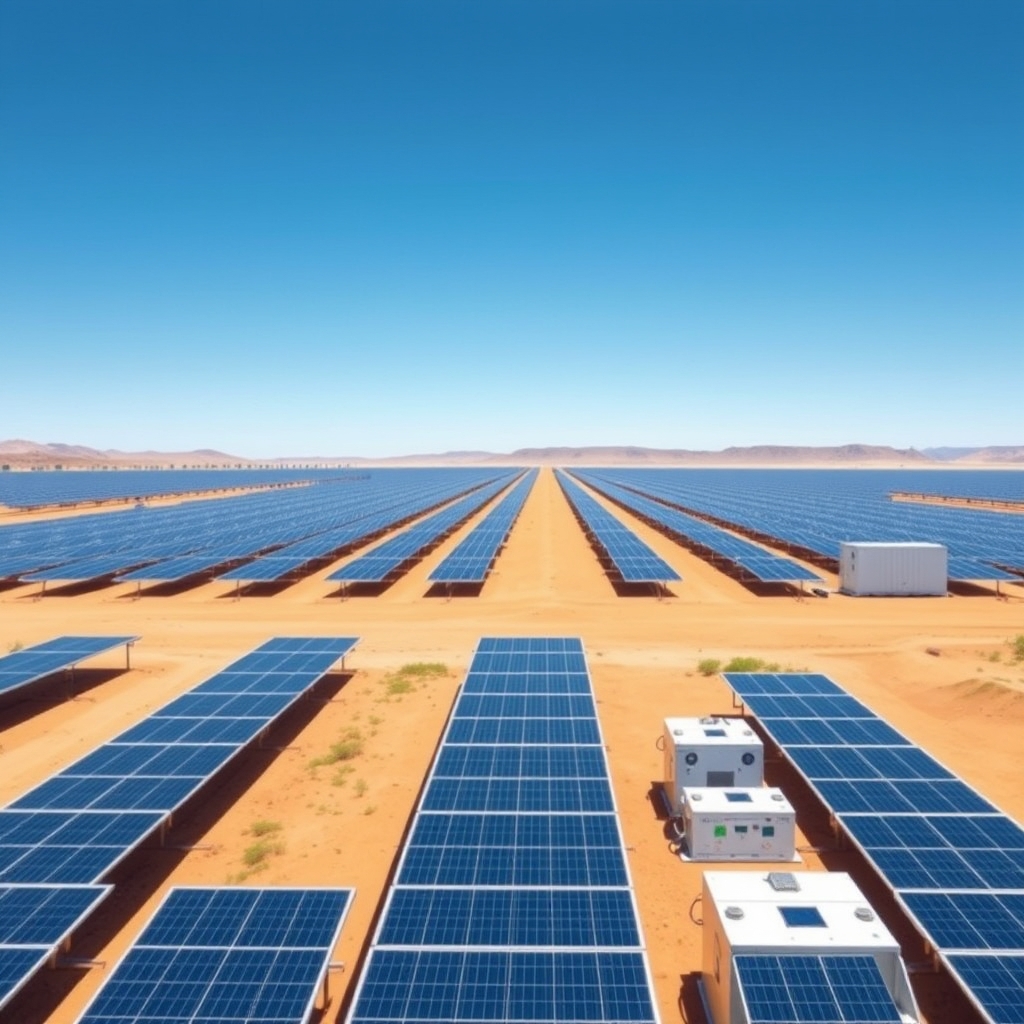
Renewable Watch reports that Rajasthan Solar Park Development Company Limited has concluded a 2,450 MW solar auction. The selected projects are slated for development at the Pugal Solar Park in Rajasthan. This allocation represents a substantial addition to the state’s renewable energy infrastructure, focusing on large-scale solar generation.
The auction includes a significant component for grid stability and energy management. Specifically, the projects incorporate 1,600 MW of battery energy storage systems, with a total capacity of 6,400 MWh. This integration of storage aims to enhance the reliability of the solar power supply, allowing for better management of intermittent generation. The move underscores the growing importance of hybrid solar-storage models in modern energy grids.
Lot Structure and Allocation
The 2,450 MW capacity is divided into two distinct lots, each pairing solar generation with specific battery storage requirements. Lot 1 constitutes the majority of the award, comprising 2 GW of solar capacity paired with 1,320 MW and 5,280 MWh of storage. This lot is further subdivided into eight individual plots, each sized at 250 MW. Lot 2 is smaller in scale, offering 450 MW of solar capacity alongside 280 MW and 1,120 MWh of storage, structured as two 225 MW plots.
| Lot | Solar Capacity | Storage Power | Storage Energy | Plot Configuration |
|---|---|---|---|---|
| 1 | 2 GW | 1,320 MW | 5,280 MWh | Eight 250 MW plots |
| 2 | 450 MW | 280 MW | 1,120 MWh | Two 225 MW plots |
This tiered structure allows developers to bid on different scales of hybrid projects. The split between the large Lot 1 and the smaller Lot 2 provides entry points for a wider range of project developers, from those managing multi-gigawatt portfolios to firms focusing on mid-scale installations. By defining storage capacity in both power (MW) and energy (MWh), the auction ensures that bidders account for both the peak discharge rate and the total duration of energy supply. This dual metric is essential for grid operators who need predictable, sustained output during peak demand periods, distinguishing these projects from simple solar farms without long-duration storage capabilities.
Winning Bids and Tariffs
NLC India Renewables Limited secured the largest single award, capturing 1 GW of solar capacity paired with 660 MW and 2,640 MWh of storage. Their bid landed at Rs 3.53 per kWh, a rate that reflects the premium attached to large-scale hybrid infrastructure. In the same price bracket, Rama Reflection India Private Limited won a 250 MW solar plot with 165 MW and 660 MWh of storage, also at Rs 3.53 per kWh. These consistent tariffs suggest a stable cost floor for developers bidding on substantial storage-integrated lots, where capital expenditure for battery systems significantly influences final pricing.
Coal India Limited emerged as a diversified winner, securing awards in both lots. For Lot 1, the state-owned utility won 750 MW of solar capacity with 495 MW and 1,980 MWh of storage at Rs 3.54 per kWh. A slight price advantage was achieved in Lot 2, where Coal India bid Rs 3.42 per kWh for 225 MW of solar and 140 MW of storage. The lower tariff in the smaller lot indicates that reduced scale can sometimes yield more competitive pricing, potentially due to lower logistical complexity or specific bid strategies.
Leo Energies 6 claimed the remaining capacity in Lot 2 at Rs 3.43 per kWh. This bid sits just one paisa above Coal India’s Lot 2 rate, highlighting the tight competition in the smaller segment. The clustering of bids in the Rs 3.42 to 3.54 range demonstrates a mature market where developers have finely tuned their cost models. Such precision is critical in storage-heavy auctions, where the levelized cost of energy must account for both the solar array and the battery’s degradation over its operational life.
Operational Constraints and Offtake
- Maximum capacity utilisation factor capped at 28 percent
- Excess generation sold to Rajasthan Urja Vikas and IT Services Limited
- Purchase price for surplus power set at 50 percent of the winning tariff
The 28 percent capacity utilisation factor serves as a strict operational limit for the awarded projects. This metric restricts the total annual energy output relative to the installed capacity, ensuring that the solar arrays do not overproduce beyond grid absorption limits. By capping utilisation, the auction design prevents curtailment issues that can arise when generation exceeds transmission capacity or local demand. Developers must size their systems and manage operations within this boundary, which directly impacts the levelized cost of energy and the financial viability of the battery storage integration.
Surplus energy generated above this operational threshold is not wasted but redirected to a specific off-taker. Rajasthan Urja Vikas and IT Services Limited is designated to purchase this excess power at a rate equal to half the winning tariff. This arrangement creates a secondary revenue stream for project owners, mitigating the financial risk associated with generation curtailment. For investors, this guaranteed offtake for surplus power provides additional cash flow stability, while the state utility gains access to extra renewable capacity without incurring the full cost of primary generation. The reduced price point reflects the lower value of intermittent surplus power compared to firm, scheduled energy delivered under the main contract.
What to watch
Attention now shifts to the physical realization of these awards. Developers must secure land, finalize battery supply contracts, and navigate local permitting processes before construction begins. The 28 percent capacity utilization cap will likely dictate operational strategies, forcing project owners to carefully schedule battery discharge cycles to maximize revenue while staying within strict output limits. Investors should monitor whether the secondary offtake arrangement with Rajasthan Urja Vikas and IT Services Limited functions as an effective financial buffer. If surplus power sales consistently hit the 50 percent tariff threshold, it could stabilize cash flows for projects facing curtailment. The tight bid clustering seen in the auction suggests a mature market, but execution remains the primary variable. Success will depend on how well developers manage the complex interplay between solar generation peaks and battery degradation over the project’s lifespan. Grid operators will also need to integrate these large storage blocks smoothly, ensuring that the promised reliability enhancements translate into tangible grid stability for consumers.
Source: Renewable Watch. This article is an original Luminity report based on the linked source.