
CO2 heat pump prototype shows 18.7% COP rise with solar assist
An Italian research team tested a 10 kW CO2 heat pump prototype in Rome, finding that higher solar irradiance improved efficiency and heating capacity. The study, published in Applied Thermal Engineering, also developed neural networks to predict performance and assess economic viability across different climates.
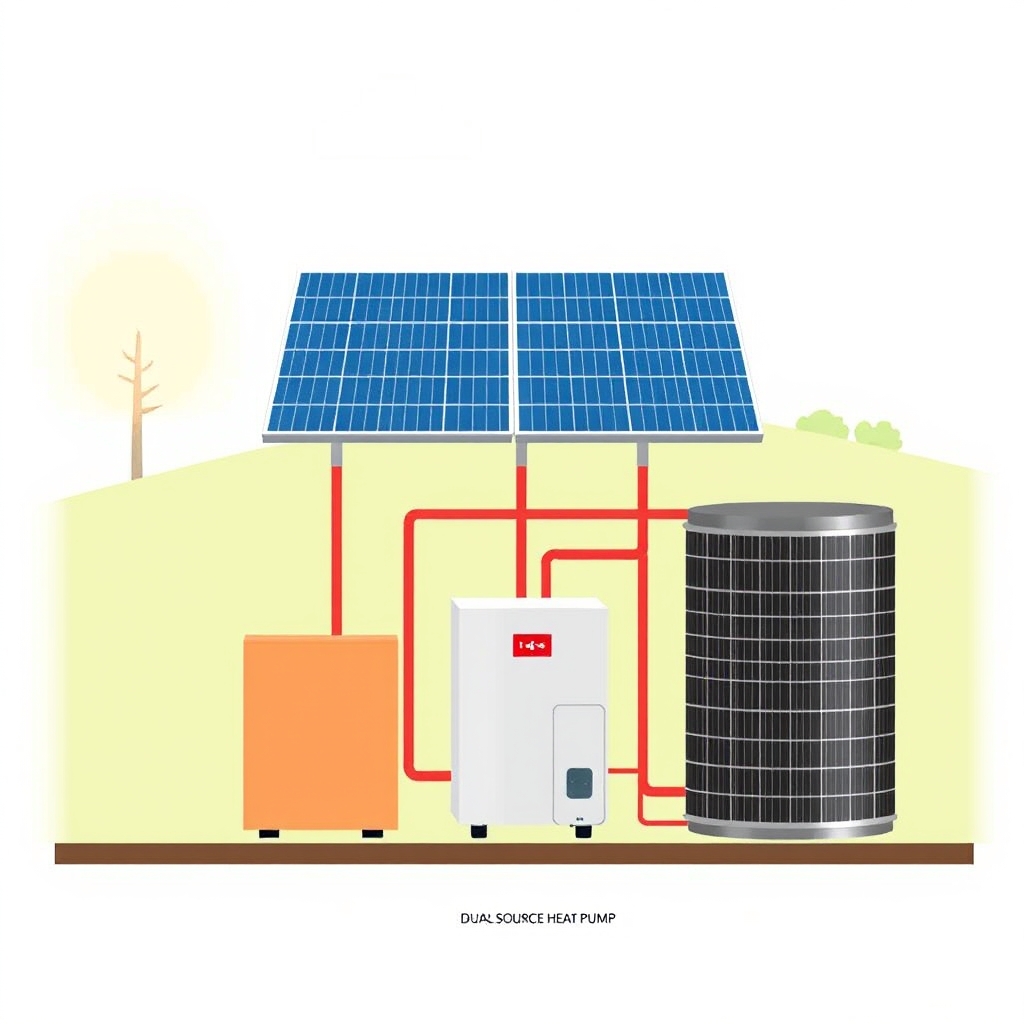
A research team from the University of Naples Federico II and ENEA in Italy has developed a 10 kW direct-expansion, dual-source heat pump prototype utilizing CO₂ refrigerant. The unit is currently located at a research center in Rome. It can draw heat from either ambient air or solar collectors, and in solar operation its coefficient of performance (COP) rose by 18.7% as irradiance increased, pv magazine reported.
Experimental Setup and Data
The prototype operates in two distinct modes: Air-Mode, which uses a fan-assisted evaporator, and Sun-Mode, which utilizes photovoltaic-thermal (PVT) collectors. The solar array consists of ten units featuring copper tubes, mounted on a south-facing surface with a 48-degree tilt. During testing, the system draws from a 300-liter water storage tank, with the water inlet held at 20 C and the flow rate adjusted to reach an outlet temperature of approximately 60 C.
Researchers varied the compressor frequency between 50 Hz and 70 Hz to assess performance across different loads. The experimental campaign generated a total of 307 tests, split into 164 runs in air mode and 143 in solar mode. To ensure data precision, sensors recorded measurements every 0.5 seconds, with values averaged over five-second intervals.
Performance Response to Irradiance
| Metric | Initial Value | Final Value | Change |
|---|---|---|---|
| Irradiance | 322 W/m² | 904 W/m² | +572 W/m² |
| Evaporation Temperature | 4 C | 12.9 C | +8.9 C |
| Heating Capacity | 8.75 kW | 10.6 kW | +21.1% |
| COP | – | – | +18.7% |
As irradiance climbed from 322 W/m² to 904 W/m², the evaporation temperature rose from 4 C to 12.9 C. This thermal lift allowed the system to increase its heating capacity by 21.1%, moving from 8.75 kW to 10.6 kW. Consequently, the coefficient of performance improved by 18.7%. The higher evaporation temperature reduces compressor work, directly driving the efficiency gain observed in the COP figures.
Mode Selection and Economic Analysis
To overcome the constraints imposed by non-uniform experimental data, the research team employed artificial neural networks (ANNs) to forecast system behavior over an expanded operational range. The findings show that Air-Mode maintains superior efficiency at low irradiance levels, attributed to the reduced thermal resistance of the air evaporator. Accordingly, the results establish a specific minimum irradiance level beyond which Sun-Mode offers better operational performance.
Although the direct electrical gains from the source-switching approach are modest, capping out at roughly 100–120 kWh/year in optimal scenarios, the concurrent power output from the PV/T array plays a major role in the system’s total economic viability. A supplementary thermo-economic evaluation highlighted a strong correlation with local climate factors. The estimated simple payback duration spans from about 6–10 years in regions with abundant solar resources to more than 20 years in areas with less favorable conditions. These estimates derive from annual simulations performed for Rome, Tenerife, San Diego, Toronto, Mexico City, Perth, and Beijing, using five domestic hot water demand profiles and a 900-liter storage tank. The team also compared performance at heating capacities of 8.5 kW and 10 kW to find the best conditions for switching between air and solar operation.
What to watch
The comprehensive research, titled "CO₂ dual-source (air/solar) heat pump on-field testing: results and performance maps development for optimal mode selection," was published in Applied Thermal Engineering. The pv magazine report does not give the precise minimum irradiance level at which solar mode surpasses air mode.
Source: pv magazine. This article is an original Luminity report based on the linked source.