
Massachusetts cranberry bogs yield first harvest under solar panels
Greenbacker Renewables has completed the first cranberry harvest from bogs in Plymouth and Kingston, Massachusetts, equipped with overhead solar arrays. The dual-use projects, installed by Distributed Energy Infrastructure, demonstrate a viable model for reviving financially unviable wetland crops.
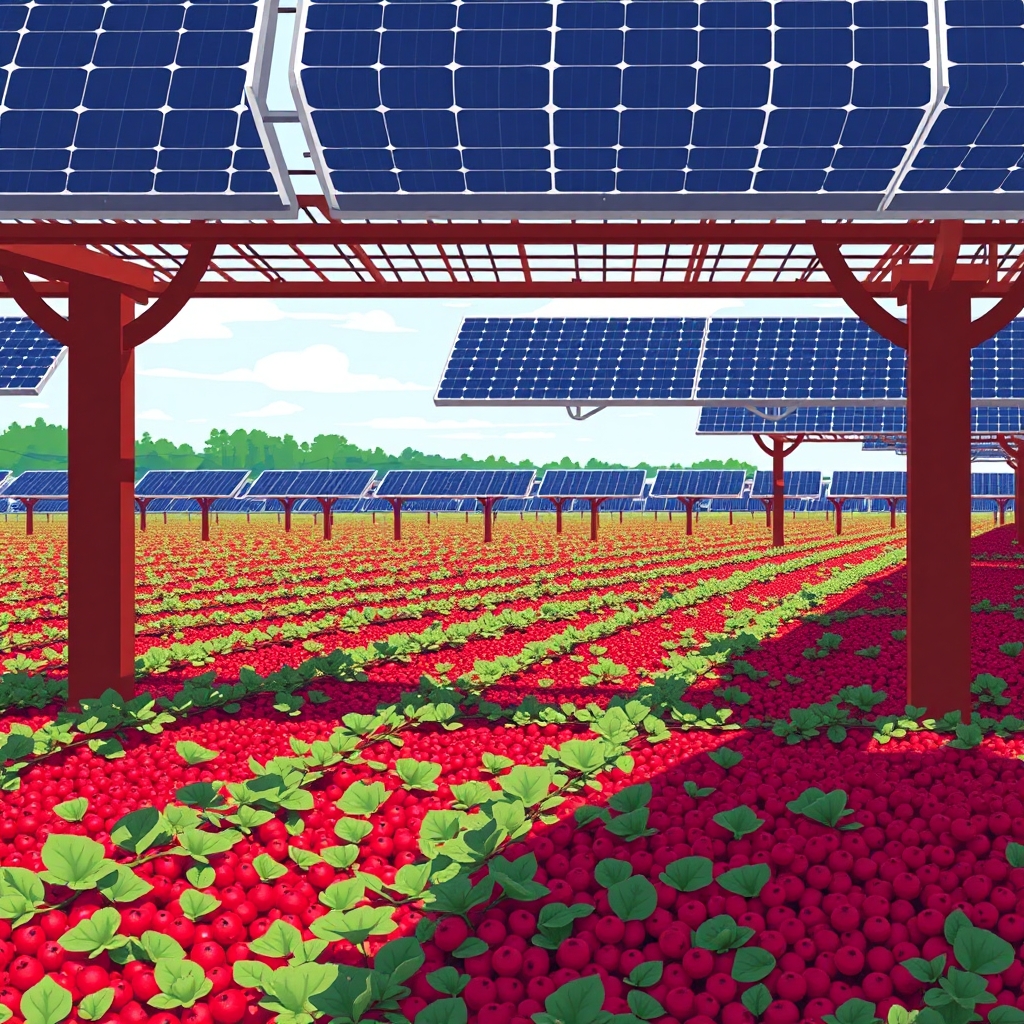
Solar Power World reports that Massachusetts has recorded its first cranberry harvest from bogs equipped with overhead solar panels. The yield came from two distinct projects: Black Cat Agrivoltaics in Plymouth and Ring Road Agrivoltaics in Kingston. This marks a notable development in the state’s agricultural energy sector, demonstrating that dual-use land management can support both power generation and traditional farming.
The successful harvest highlights the potential for agrivoltaics to integrate renewable energy infrastructure with existing crop production. While the specific impact on cranberry quality or yield volume remains under observation, the initial results confirm that the bogs can operate effectively under the partial shade provided by the solar arrays. The projects in Plymouth and Kingston serve as early examples of how farmers and energy developers might collaborate to maximize land utility without sacrificing agricultural output.
Project Specifications and Partners
Greenbacker Renewables owns both installations, while Distributed Energy Infrastructure (DEI) handled the physical construction. The two sites differ significantly in scale, reflecting varied land availability and local grid connections. Black Cat Agrivoltaics in Plymouth operates at a 1-MW capacity with 2.7-MWh of battery storage. In contrast, Ring Road Agrivoltaics in Kingston is much larger, featuring 4.4-MW of solar capacity paired with 13.5-MWh of storage.
| Project | Location | Capacity (MW) | Storage (MWh) |
|---|---|---|---|
| Black Cat | Plymouth | 1.0 | 2.7 |
| Ring Road | Kingston | 4.4 | 13.5 |
These figures illustrate the typical structure of modern agrivoltaic developments. For developers, combining generation with on-site storage allows them to shift energy output to peak demand periods, maximizing revenue potential. Battery systems typically store excess solar power during midday when sunlight is strongest, then release it during evening hours when electricity prices rise. This temporal arbitrage improves project economics without relying solely on real-time grid sales. Investors often view such hybrid models as more resilient because they reduce exposure to volatile spot market prices. Localizing storage minimizes transmission losses, which is particularly relevant for distributed generation projects that feed directly into regional distribution networks. The disparity in size between the Plymouth and Kingston sites suggests that land constraints and local interconnection costs heavily influence final project design. While the smaller Plymouth site may serve as a focused pilot for specific agronomic testing, the larger Kingston installation likely aims to capture broader economic benefits through scale. Both configurations demonstrate that agrivoltaics can adapt to different site conditions while maintaining the core dual-use objective of supporting both crop growth and clean energy production.
Economic and Agronomic Context
Before the installation of the overhead arrays, these specific cranberry bogs sat fallow and financially unviable. For many small-scale agricultural operations, the high maintenance costs of wetland farming often outstrip the revenue generated by the harvest, particularly when market prices fluctuate. In such scenarios, landowners face a difficult choice: abandon the crop entirely or seek alternative revenue streams that do not require active daily labor. Solar leasing offers a compelling solution, transforming idle or struggling farmland into a consistent income source. Typically, developers pay landowners an annual lease fee, which provides a stable financial baseline independent of crop yields or commodity prices. This predictable cash flow helps stabilize farm finances and can even fund necessary equipment upgrades or soil management practices that might otherwise be deferred.
For Iain Ward, the manager overseeing these operations, the integration of energy infrastructure with traditional farming presented distinct hurdles. He described the process of building solar projects over active perennial wetland crops as an exciting challenge. This sentiment reflects a broader trend in the sector, where engineers and agronomists must collaborate closely to ensure that panel height, orientation, and spacing do not disrupt the delicate hydrology required for cranberry cultivation. Unlike annual row crops, perennial wetland plants like cranberries require specific water management techniques, such as flooding during winter to protect against frost and pests. Navigating these agronomic constraints while maximizing solar exposure requires precise planning. The success of these initial harvests suggests that such dual-use arrangements can revitalize economically struggling agricultural land, offering farmers a pathway to sustainability without abandoning their historical farming practices.
Industry Recognition and Advocacy
- Iain Ward stated, "These projects prove that with the right approach, dual-use solar can be applied."
- Both installations were named finalists in the North American Agrivoltaics Awards.
- Ward and Distributed Energy Infrastructure serve as founding members of the Solar & Farming Association.
The selection of the Plymouth and Kingston sites as award finalists underscores the growing institutional interest in agrivoltaic models. Such recognition typically signals to the broader market that specific technical and agronomic configurations are meeting rigorous industry standards. For investors and policy-makers, award status often serves as a validation mechanism, reducing perceived risk associated with novel land-use strategies. It suggests that the integration of energy generation with perennial wetland crops is not merely an experimental curiosity but a replicable framework worthy of wider adoption.
Beyond individual project accolades, the active participation of key stakeholders in professional advocacy groups strengthens the sector’s long-term viability. Founding membership in organizations like the Solar & Farming Association indicates a commitment to shaping industry norms and sharing technical knowledge. These associations usually work to establish best practices, facilitate peer-to-peer learning, and advocate for regulatory clarity. By engaging in collective advocacy, developers and operators help build a supportive ecosystem that can address common challenges, such as permitting hurdles or grid interconnection issues. This collaborative approach fosters a more coherent industry narrative, moving beyond isolated case studies toward standardized methodologies that benefit developers, landowners, and the wider energy grid.
What to watch
The immediate focus for stakeholders shifts from installation metrics to long-term agronomic performance. While the initial harvest marks a successful proof of concept, the true test lies in the coming seasons. Readers should monitor whether the partial shading provided by the overhead arrays affects berry size, flavor profile, or overall yield consistency over a multi-year cycle. Perennial crops are sensitive to subtle environmental changes, and tracking these variables will determine if the dual-use model remains viable beyond the novelty phase.
Simultaneously, the regulatory environment will play a decisive role in how quickly this model scales. Permitting processes for agrivoltaics often lag behind the technology itself, as local zoning laws may not clearly define dual-use land. Watching for updates in state-level incentives or streamlined approval pathways will reveal whether developers can replicate these sites with greater speed and lower administrative friction.
Finally, the broader market will look to the Solar & Farming Association’s evolving guidance. As the industry matures, standardized best practices for panel height, spacing, and hydrology management will become critical. These guidelines will help de-risk future projects for investors and ensure that new installations respect the specific needs of wetland agriculture. Success here depends less on individual project outcomes and more on the collective ability to codify what works, turning isolated experiments into a reliable template for nationwide adoption.
Source: Solar Power World. This article is an original Luminity report based on the linked source.