
Laser method achieves over 95% silver recovery from aged solar panels
University of Glasgow researchers have demonstrated a laser-based recycling technique that selectively recovers more than 95% of silver from end-of-life crystalline silicon modules. The study, published in Communications Materials, shows that targeting the encapsulant-silicon interface with a fiber laser enables high-purity material separation without energy-intensive pyrolysis.
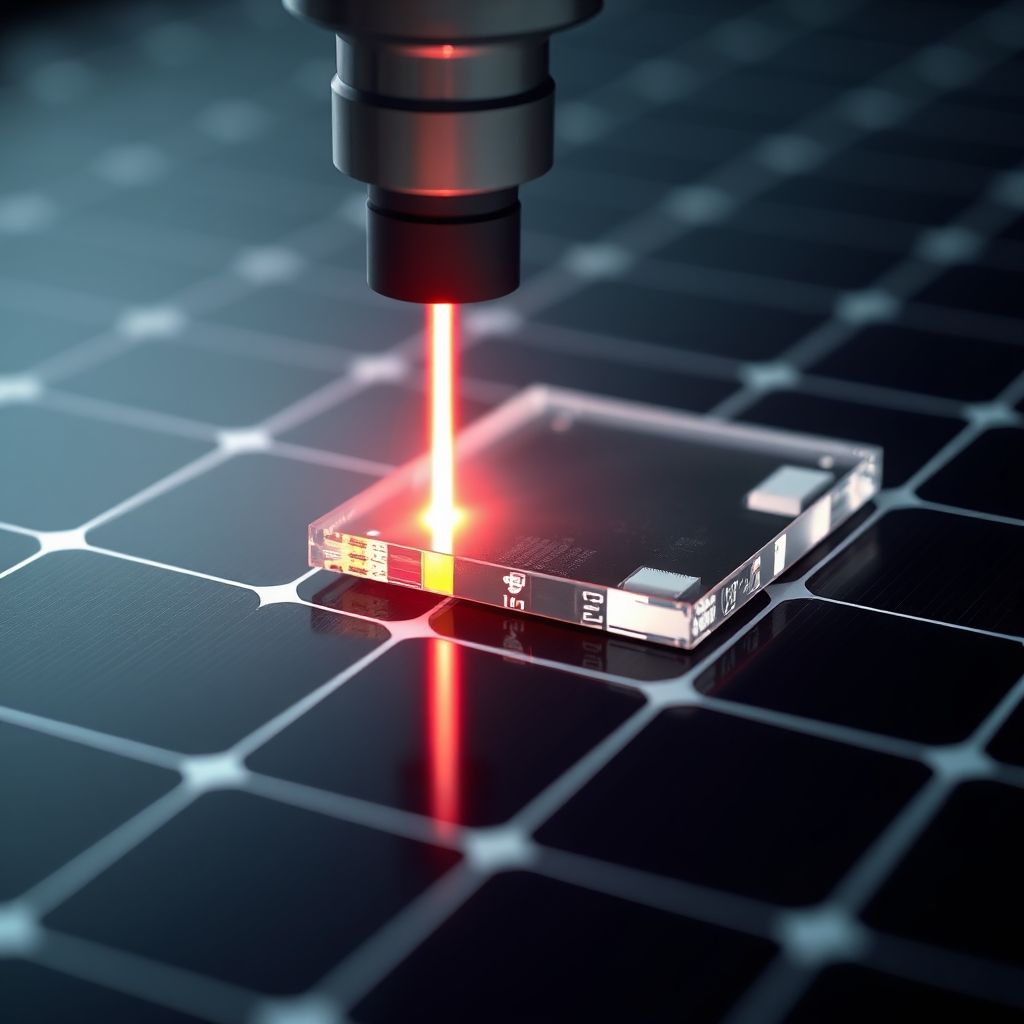
Scientists at the University of Glasgow have engineered a laser-based delamination method for recycling aged crystalline silicon solar modules. The study reports that this approach yielded silver extraction selectivity exceeding 95% across both module types evaluated. These results appeared in Communications Materials.
Laser Delamination Process
This recycling method follows a two-step procedure: first, hot-knife glass removal, followed by the use of laser energy to detach the ethylene-vinyl acetate (EVA) encapsulant from the silicon cells. The investigation employed a 1,064 nm fiber laser directed at the boundary between the EVA and silicon layers. Testing covered specimens varying in size from 20 mm × 20 mm to larger dimensions, while laser settings were modulated using pulse frequencies of 30 kHz, 40 kHz, and 50 kHz.
The research pinpointed distinct power levels required for successful delamination. Detachment of the EVA began at roughly 12 W to 14 W. Efficiency rose as laser power climbed, reaching near-total separation at 18 W to 20 W and above, extending to the peak test value of 27 W.
Material Recovery Results
The laser delamination process yielded three distinct material streams: intact EVA films, isolated busbars, and silicon-rich cell powder. To recover the silver, researchers subjected the powder to a two-stage leaching sequence. First, 1 M sodium hydroxide removed aluminum, followed by an iron(III) chloride-choline chloride solution that extracted the silver.
| Material Metric | Percentage Range |
|---|---|
| Silver Extraction Selectivity | >99% (one case) |
| Silver in Powder Mass | 1.08% – 1.38% |
| Aluminum Removed | 7.79% – 8.54% |
Research Context and Claims
Scientists at the University of Glasgow highlight that recycling end-of-life crystalline-silicon photovoltaic modules remains challenging due to the strong adhesion of the ethylene-vinyl acetate encapsulant to cell interfaces. The group contends that their laser-induced delamination offers a dry and selective method for removing this material. They assert that, to the best of their knowledge, this marks the most selective silver extraction reported for aged panels.
The investigators clarify that by focusing the laser exclusively on the boundary between the encapsulant and silicon, the integrated hot-knife and laser approach should consume less energy than pyrolysis techniques. This project is conducted in partnership with the Fraunhofer Center for Silicon Photovoltaics and Princess Nourah bint Abdulrahman University.
Background
- Luminity reported on 30 October that researchers evaluated environmental and economic trade-offs for recycling frameless glass-glass modules with polyolefin elastomer encapsulation, noting the tension between reducing treatment intensity and maintaining high material recovery.
- The modules tested in the current laser delamination study were aged approximately 10 to 13 years.
- The study does not provide a timeline for commercial implementation of the technique.
Analytical Validation and Residuals
Post-treatment X-ray diffraction indicated that crystalline silicon remained intact, whereas the diffraction peaks corresponding to silver and aluminum vanished. The researchers benchmarked their extraction outcomes against a nitric acid standard and evaluated separation efficacy through sample weighing, microscopy, spectroscopy, and thermal analysis. Traces of metallic residue were detected within the EVA, concentrated near the busbar contact areas. The study observed that primary recycling methods typically depend on shredding or bulk thermal processing, resulting in mixed material fractions.
Source: pv magazine USA. This article is an original Luminity report based on the linked source.