
Study finds targeted recycling of glass-glass modules trades value for lower impact
Researchers from the University of New South Wales and Gdansk University of Technology assessed three recycling pathways for frameless glass-glass solar modules, finding that targeted fractionation reduces environmental burdens compared to whole-module treatment. While all scenarios yielded positive operational margins, the most intensive recycling method achieved the lowest processing burden, though it recovered less material value than simpler thermal and chemical approaches.
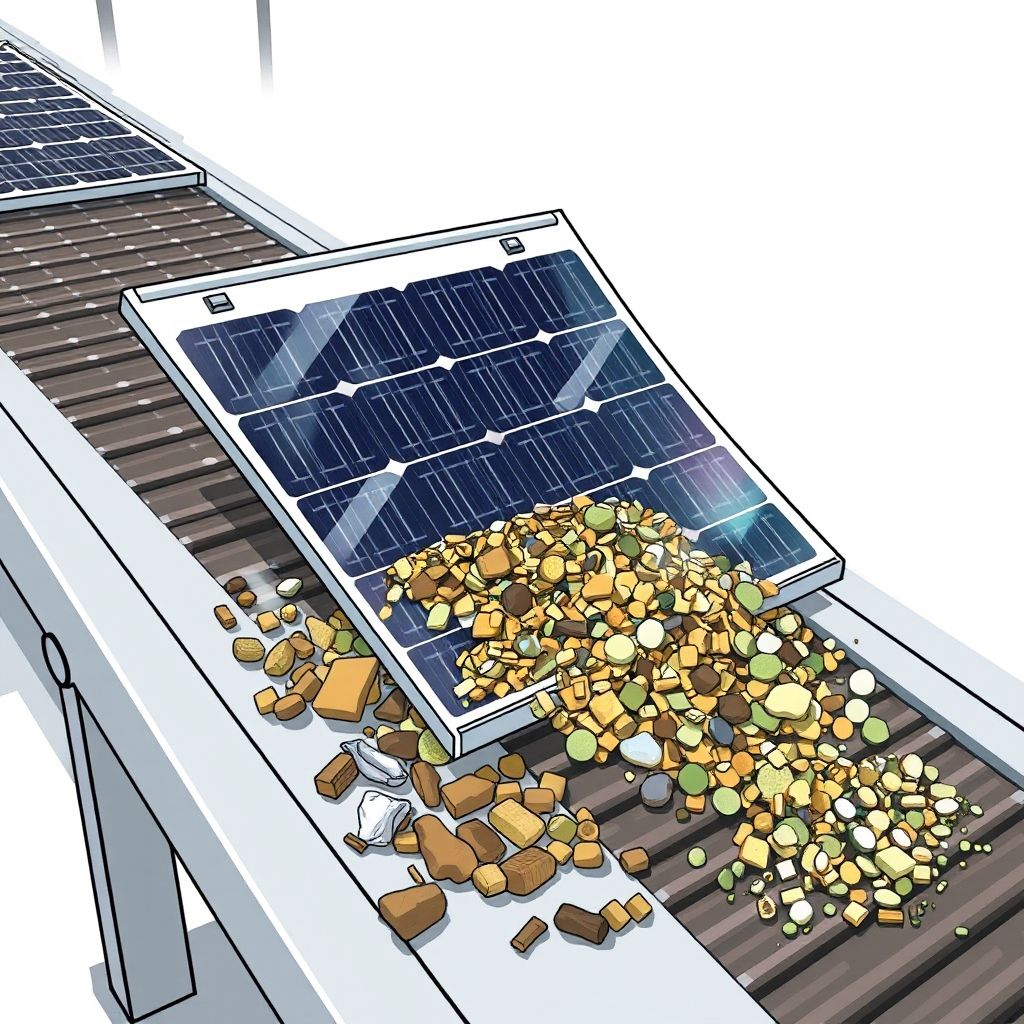
Researchers have evaluated the environmental and economic trade-offs of recycling frameless glass-glass photovoltaic modules, according to a report reported by pv magazine. The study specifically examined modules utilizing polyolefin elastomer (POE) encapsulation, a common material in dual-glass designs that lack a backsheet. By analyzing one 27 kg module, the team compared three distinct recycling scenarios to determine how targeted recovery processes impact overall sustainability metrics.
Methodology and Scenarios
The study compares three distinct recycling pathways for frameless glass-glass modules. Scenario 1 applies thermal and chemical treatment to the whole module. Scenario 2 combines mechanical treatment with selective thermal processing. Scenario 3 adds further fractionation using electrostatic corona separation. Within these scenarios, the researchers evaluated two chemical recovery routes: one using sodium hydroxide, ammonia, and hydrogen peroxide, and the other using nitric acid and hydrogen peroxide.
The environmental assessment employed a “gate-to-gate” life cycle analysis based on ReCiPe 2016 midpoint indicators. This approach measures impacts from raw material input to finished product output. For the economic evaluation, the team calculated process-level operational margins. These figures exclude capital costs and equipment maintenance, isolating the direct financial performance of the recycling operations themselves.
Environmental and Economic Trade-offs
| Metric | Scenario 1 | Scenario 2 | Scenario 3 |
|---|---|---|---|
| Processing Burden | Higher | Moderate | Lowest |
| Operational Margin | Positive | Positive | Positive |
Specific recycling routes lowered energy consumption and global warming potential relative to standard practices, with Scenario 3 typically exhibiting the minimal processing load. Conversely, treating entire modules provided greater advantages in material-focused areas due to enhanced material retrieval rates. From a financial perspective, every scenario generated positive margins, although the cost structure is significantly influenced by silver. Although silver represents a negligible portion of the module's weight, it commands the majority of recovered material income, accounting for as much as 47% of the total recoverable module value, per findings from the University of New South Wales, Gdansk University of Technology, and the Polish Academy of Sciences.
Limitations and Market Context
- Future recycling revenue is expected to fall due to decreasing silver content in newer panels.
- The modeled scenarios depend on electrostatic separation rates and material valuations sourced from existing literature, rather than empirical data.
- Experimental verification of electrostatic recovery and substitution efficacy for the specific material streams analyzed remains lacking.
- Frameless solar modules are anticipated to hold steady at a 5% market share throughout the next ten years.
- Soli Tek supplied the materials used in this investigation.
- This work was conducted by Aistis Rapolas Zubas, Jolita Kruopienė, Gintaras Denafas, Floriana La Marca, and Alessandra Bonoli, and appeared in Solar Energy Materials and Solar Cells.
“The results highlight the trade-offs between reducing treatment intensity and maintaining sufficiently high material recovery and value,” the researchers wrote.
Source: pv magazine. This article is an original Luminity report based on the linked source.