
Indian apartment transformer limits make simultaneous EV charging an engineering puzzle
With most urban Indians living in apartments, existing bulk electricity connections leave minimal spare capacity for electric vehicle charging. Legal challenges are underway as courts push for guidelines to prevent arbitrary rejections of charger installations.
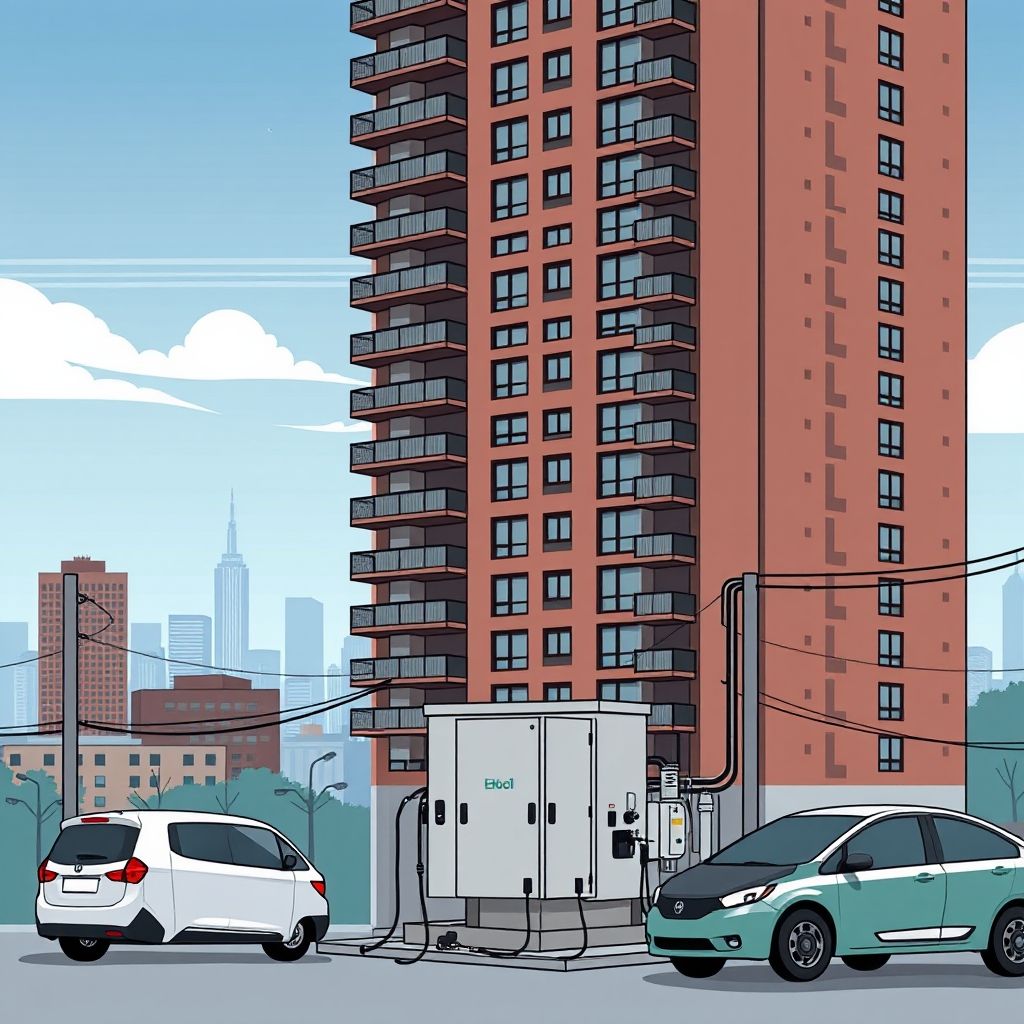
In major Indian metropolitan areas, between 70% and 75% of urban households reside in multi-family apartments, according to data from Kazam and AEEE. This housing model creates a specific infrastructure challenge for electric vehicle adoption, as these societies typically purchase electricity through bulk sanctioned load agreements with local distribution companies.
The Capacity Crunch
A standard 250 kVA transformer delivers between 215 kW and 225 kW of real active power, assuming a power factor of 0.85 to 0.90. During summer months, domestic peak loads typically consume 75% to 85% of the rated capacity, drawing 165 kW to 190 kW. This leaves a limited operating buffer of 25 kW to 60 kW for a complex of 100 flats.
Five or six 7.4 kW chargers operating together pull 37 kW to 44 kW, a demand that exceeds the 30 kW buffer. When eight cars charge simultaneously, the total load reaches 59.2 kW. This specific load profile causes transformer thermal overload.
Installation Costs and Safety
- The expense of wiring for EV charging units falls between ₹25,000 and ₹50,000 (US$280–560).
- Safety regulations in India require the use of a 40A Type C miniature circuit breaker alongside a 30 mA Type A RCBO.
- Earthing pits undergo testing to verify that their resistance stays below 2 ohms.
Legal Push for Guidelines
Legal intervention has begun to address the administrative barriers hindering EV charging in apartments. In the 2025 case Amit Dholakia v. The State of Maharashtra, the Bombay High Court urged authorities to establish clear guidelines to prevent the arbitrary rejection of No Objection Certificates (NOCs) required for charger installations. This judicial direction targets the unpredictable approval processes that currently stall individual charging setups within residential complexes.
The issue has since escalated to the nation's highest court. In early 2026, the Supreme Court of India issued a notice on a Public Interest Litigation specifically concerning bans on electric vehicle chargers. This development signals that the conflict between building management restrictions and resident charging rights is now a matter of national legal scrutiny.
Despite these judicial actions, practical implementation remains uncertain. There is currently no defined timeline for utility companies to upgrade transformers or for distribution companies to approve increased sanctioned loads. Until these technical and administrative frameworks are resolved, the capacity constraints identified in shared infrastructure will continue to limit the feasibility of simultaneous charging, leaving residents dependent on legal precedents rather than standardized technical protocols.
Cable Physics and Committee Hesitation
The span separating a home’s meter from its designated parking space determines the necessary engineering specifications. In multi-story buildings, meters reside in ground-level panel rooms or utility shafts, whereas cars are stored underground. Transmitting 32 amps across an 80 to 120-metre distance requires robust 10 sq mm armoured copper cabling to control voltage drop and thermal buildup, superseding the usual 4 or 6 sq mm domestic wiring. A detector integrated into approved EV chargers manages pure 6 mA DC fault protection, working alongside the required 30 mA Type A RCBO.
Bureaucratic hurdles remain even when occupants pay the entire wiring expense. Resident Welfare Association boards, generally made up of non-technical volunteer residents, often refuse No Objection Certificates based on three distinct worries: apprehension about battery fires in confined concrete basements, conflicts regarding charges for unmetered line losses when chargers draw from shared power, and dread that permitting one setup will cause uncontrolled wiring disorder on common parking levels. Many boards do not realize that certified chargers render the cable completely inert until an electronic handshake secures with the vehicle.
Vertical shafts and basement cable trays turn into crowded fire risks once ten or fifteen residents pursue separate installations. The initial occupant in a wing can readily route a cable through the vertical riser, yet later applications burden the existing infrastructure.
Source: CleanTechnica. This article is an original Luminity report based on the linked source.