
Equator Renewables Asia introduces 250 kW containerized solar system SolarBox
Singapore-based developer Equator Renewables Asia has introduced SolarBox, a preassembled solar system housed in a standard shipping container for rapid deployment at industrial sites. The company signed a memorandum of understanding with Aster Power to assess the system's feasibility at facilities in Singapore.
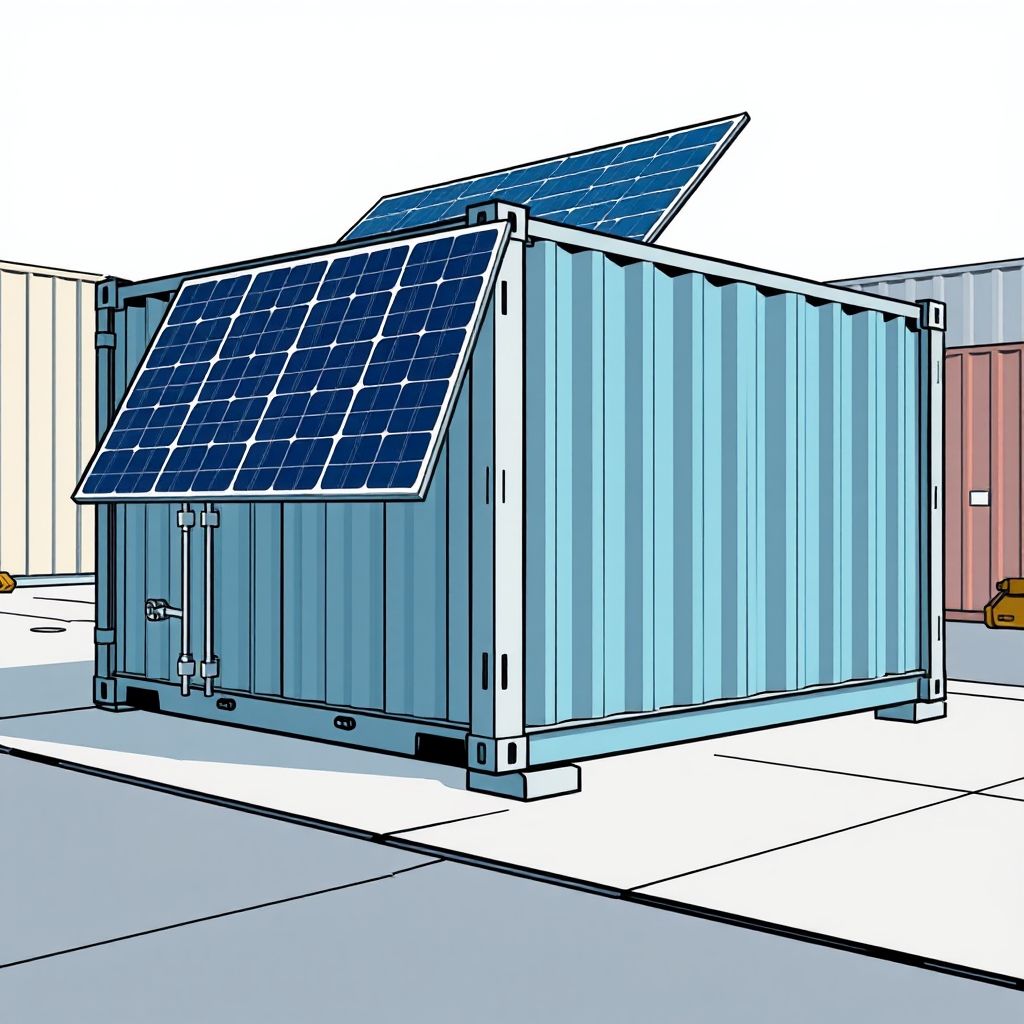
Singapore-headquartered Equator Renewables Asia has launched SolarBox, a modular, container-based solar solution built for swift installation. According to the firm, the technology is specifically engineered to serve industrial facilities, off-grid areas, and short-term power needs.
Technical Specifications
A standard 40-foot high-cube shipping container houses the SolarBox, which packs between 235 kW and 250 kW of photovoltaic generation. The core of this setup consists of 368 n-type TOPCon bifacial panels, with every unit specified at 640 W. In the baseline arrangement, these components yield a total DC output of roughly 235.5 kW. Each individual panel has physical dimensions of 2,382 mm × 1,134 mm × 30 mm and is backed by a 25-year power guarantee.
When activated, the ready-to-go array extends to roughly 120 meters. This transformation is made possible by connected folding PV tables attached to a roller-wheel frame, enabling the tight container to open up into a stretched-out solar field.
Deployment and Configuration
- A crew of two can set up the system in under three hours, with the task often completing in roughly two hours when conditions are favorable.
- By reducing reliance on traditional foundations, the structure can be moved as land-use needs evolve.
- The standard setup features two 100 kW inverters for a total 200 kW AC output, though 115 kW inverter choices are also available per manufacturer data.
- The electrical system delivers 400 V three-phase power at either 50 Hz or 60 Hz.
- Built-in capabilities cover DC and AC safety, surge defense, grounding, remote surveillance, and energy tracking.
- The unit functions in both grid-tied and standalone off-grid modes.
- It allows for the optional addition of battery storage units and diesel generators.
- A pre-wired design connects to the site’s electrical grid via one AC junction, minimizing local electrical labor.
Scale and Logistics
SolarBox, provided by Equator Renewables Asia, is available in setups spanning from one 250 kWp module to larger multi-container arrays. A 1 MW configuration is achieved by linking four units, whereas the firm’s reference hybrid microgrid design incorporates three units for a total of 750 kW, paired with 964 kWh of battery capacity. For utility-scale projects, the plan scales up to 10 MW through the use of 40 units, which are interconnected using AC combiners and medium-voltage transformers.
In terms of physical dimensions, every container stands 12.19 meters long, 2.44 meters wide, and 2.90 meters high. Given a stated gross transport weight of roughly 24 metric tons, installing the system necessitates the use of standard heavy-lifting machinery.
Commercial Feasibility
Equator Renewables Asia (ERA) entered into a memorandum of understanding with Aster Power, the energy sector of the Singapore-based industrial conglomerate Aster, to investigate the implementation of SolarBox units at sites located on Singapore’s Bukom and Jurong islands. Revealed during Singapore International Energy Week in October 2026, this pact focuses on determining the technical and commercial viability of movable photovoltaic systems within transient industrial settings. ERA CEO Frank Phuan observed, "Many industrial sites have land that is only available for a limited time, which makes a fixed solar installation hard to justify. SolarBox is designed for that situation. It can be set up quickly, moved when the land is needed for something else, and redeployed elsewhere."
ERA supplied preliminary levelized cost of energy projections derived from capital expenditure, spanning from $0.0194/kWh in Australia to $0.0292/kWh in Singapore. These calculations rely on equipment pricing delivered FOB China during the third quarter of 2026, while omitting expenses for transport, setup, and supplementary items. As a result, these values must not be construed as comprehensive project-level LCOE assessments. Details regarding the commercial sale price of SolarBox and the schedule for any prospective installation at Aster’s locations remain undisclosed.
Source: pv magazine. This article is an original Luminity report based on the linked source.