
China solar export curbs consultation closes 15 November, India already affected
China's Ministry of Commerce has proposed adding 12 photovoltaic manufacturing technologies to its export-control list, with the public consultation closing on 15 November. India, which has already faced curbs on solar-manufacturing technology exports from China, is now exposed to broader restrictions that could impact its plans for thin-wafer processes and fluidised-bed polysilicon.
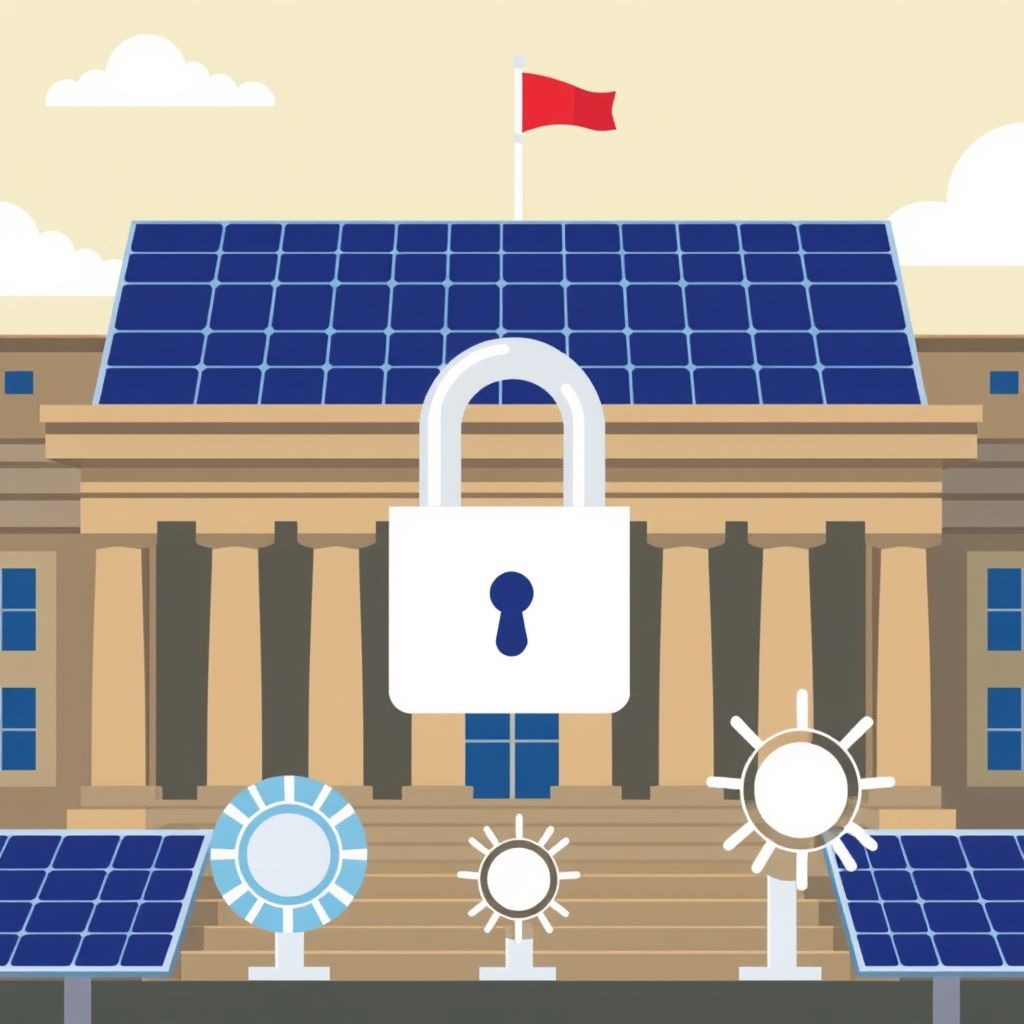
China’s Ministry of Commerce has drafted a proposal to include twelve distinct photovoltaic manufacturing techniques in its export-control registry, with the public comment window scheduled to end on 15 November. This initiative builds upon prior regulatory measures that have already curtailed the transfer of solar-production technology from China to India, as well as existing oversight of battery cells.
Per Saur Energy, the draft focuses on particular fabrication processes instead of completed modules, although the precise boundaries of the rule remain pending the forthcoming assessment.
Scope of Proposed Restrictions
This draft is embedded within a wider overhaul of China’s technology catalogue, a framework that also addresses the artificial intelligence and biotechnology fields. Beijing defends these actions by citing national security risks, contending that certain solar technologies find application in aerospace and defence contexts. The proposal draws a clear line between complete prohibitions and licensing mandates for various manufacturing techniques.
A total prohibition applies to methods for creating thin silicon wafers, perovskite and tandem solar cells, and large-scale fluidised-bed polysilicon production. The tandem cell ban specifically targets cells fabricated on wafers of at least 182 mm in size with an efficiency of 30% or higher, alongside large-area modules spanning at least one square metre. Fluidised-bed polysilicon production is cheaper and more energy-efficient than the prevailing Siemens process.
Conversely, production techniques for TOPCon, HJT, and XBC cells are subject to restrictions rather than outright bans. These approaches necessitate licensing instead of a flat prohibition. Importantly, the draft allows for the export of finished panels, cells, or wafers, concentrating solely on the foundational production technologies.
Regulatory Mechanics and Registration
The rules effective from 16 October mandate that exporters register designated overseas technology transfers, a requirement that persists until the catalogue undergoes formal revision. The draft proposal widens the previous scope by extending these controls to technology transfers globally. Following the closure of the consultation period on 15 November, China's regulators will determine whether to retain the established thresholds.
Impact on Indian Manufacturing
By the close of September, India’s operational solar capacity stood at 171.05 GW, following the addition of 20.79 GW during the first half of FY27. Although module production capabilities have exceeded 200 GW, the upstream supply chain remains exposed. At the Bharat Renewable Energy Summit, Union Minister Pralhad Joshi referenced cell capacity of roughly 45 GW, yet industry stakeholders estimated the functional cell capacity to be under 40 GW. Currently, ingot and wafer production represents less than 1% of the aggregate total, and domestic commercial-scale polysilicon manufacturing has not yet commenced.
These deficiencies are pivotal because India’s initiatives for thin-wafer methods and fluidised-bed polysilicon must now depend on non-Chinese technologies. Given that the draft bans the export of these particular production techniques, local producers face uncertainty over whether future expansions, upgrades, and equipment maintenance will suffer licensing delays if the rules are enacted as proposed. The short-term consequences hinge on three elements: the ultimate placement of TOPCon on the list, the application of the registration framework to current operations, and the pace at which European or indigenous equipment can replace Chinese components. For India, establishing a technological foundation has evolved into a supply-security imperative in addition to an industrial goal.
Industry Responses and Background
- IB Solar executed MoUs with three German partners for a 2 GW TOPCon cell line and a Centre of Excellence in Uttar Pradesh, supported by the National Solar Energy Federation of India.
- Premier Energies launched a 7 GW TOPCon plant in September, increasing its cell capacity to 10.6 GW.
- Alpex Solar opened a 2.2 GW TOPCon facility in Mathura.
- Saatvik Green Energy is conducting production tests at a 4 GW cell plant in Odisha.
- Vikram Solar plans to commence a 10 GW facility by December.
These expansions continue alongside an interim registration obligation for listed technology exports, starting 16 October 2026, which requires firms to disclose export operations prior to the finalization of rules, per an earlier report.
Source: Saur Energy. This article is an original Luminity report based on the linked source.