
Study models Paris as top EU capital for rooftop solar generation
A new study published in the journal Energy identifies Paris as the EU capital with the largest exploitable rooftop area and highest solar generation potential. Researchers from Greece note that while rooftop PV could cover up to 35% of demand in some cities, it requires complementary storage and grid upgrades to achieve climate neutrality.
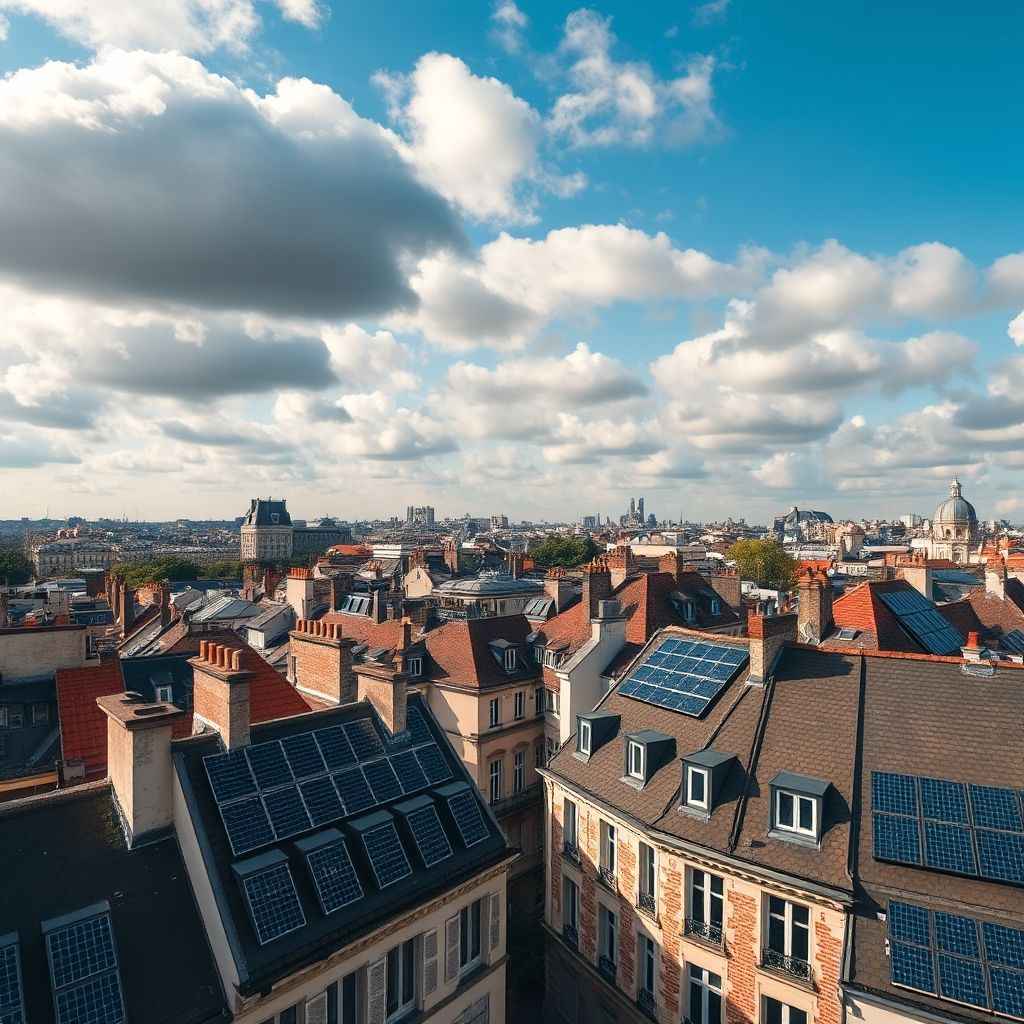
New research indicates that rooftop solar plays a significant role in urban power generation across the 27 capital cities of the European Union. These results are presented in the article “Unified framework for the assessment of rooftop solar PV electricity generation potential in EU-27,” published in the December issue of the journal Energy.
Methodology and Scope
The analytical framework for this study was constructed by researchers affiliated with Athens’ Institute for Environmental Research and Sustainable Development and the National and Kapodistrian University. This model combines urban data with a climatological record covering the period from 2008 to 2023, in addition to standardised PV simulations. Panagiotis Kosmopoulos, the corresponding author, observes that while rooftop solar offers significant potential in every European capital, the resulting output differs according to urban form, atmospheric conditions, and local electricity demand. The framework is structured to allow for reproducibility and transferability to other cities that have access to equivalent datasets.
Generation Potential by City
Paris leads the ranking with 72.2 km² of exploitable, PV-compatible rooftop area, translating to an annual generation potential of 3.810 TWh. Berlin and Warsaw follow in available roof space, while Budapest and Rome record lower generation figures despite their urban scale.
| City | Exploitable Roof Area (km²) | Annual Generation Potential (TWh) |
|---|---|---|
| Paris | 72.2 | 3.810 |
| Berlin | 52.4 | — |
| Warsaw | 51.6 | 2.506 |
| Budapest | — | 2.548 |
| Rome | — | 2.035 |
Paris combines the largest physical footprint with the highest modeled output, whereas Budapest generates more electricity than Warsaw despite lacking a reported roof area figure in this comparison.
Constraints and Loss Factors
- The physical space for photovoltaic systems is restricted in Nicosia (6.2 km²), Ljubljana (5.6 km²), and Valletta (2.6 km²).
- Annual output is notably reduced in Tallinn (0.305 TWh), Ljubljana (0.302 TWh), and Valletta (0.202 TWh).
- The study’s analytical model incorporates three specific adjustment factors to reflect the impacts of urban shading, cloud cover, and aerosol shading.
- Throughout Europe, cloud cover is recognized as the predominant cause of solar energy reduction.
- Cities in Northern and continental regions typically have more extensive rooftop surfaces than their Mediterranean counterparts, yet they suffer from higher losses due to cloud cover and seasonal fluctuations.
- High-density urban areas face intensified shading and grid congestion challenges, while less dense cities are better suited for standard rooftop installation approaches.
Panagiotis Kosmopoulos, the corresponding author, notes that although the amount of available rooftop space is the key driver of potential, atmospheric elements such as shading, clouds, and aerosols are what create disparities between cities that have comparable physical assets.
Policy Recommendations
Panagiotis Kosmopoulos, the corresponding author affiliated with the Institute for Environmental Research and Sustainable Development and the National and Kapodistrian University, notes that in top-performing urban areas, rooftop photovoltaics have the capacity to satisfy approximately 35% of overall electricity needs. Nevertheless, he contends that relying solely on rooftop PV is inadequate. Reaching climate neutrality demands the integration of storage systems, flexibility measures, grid enhancements, and other complementary renewable energy technologies.
Kosmopoulos proposes that Europe implement shared frameworks, including streamlined permitting processes, support for self-consumption, the development of energy communities, and the adoption of solar-ready building designs. However, he emphasizes that financial incentives must be tailored to local conditions. Denser urban centers might require more robust backing for collective self-consumption and energy-sharing arrangements, whereas cities possessing abundant solar resources could gain more from incentives targeting battery storage and flexibility. In northern regions, the priority should shift toward seasonal balancing and storage capabilities, while southern cities should concentrate on boosting local self-consumption and mitigating summer peak load.
In conclusion, Kosmopoulos recommends that Europe pursue a unified strategic vision while avoiding a one-size-fits-all policy approach, instead allowing local urban contexts to guide implementation. He identifies the primary obstacle not as a lack of resources, but rather the need to facilitate deployment via more intelligent policies, expedited permitting, enhanced grid flexibility, storage solutions, and strategies specific to individual urban environments.
Source: pv magazine. This article is an original Luminity report based on the linked source.