
Iranian model predicts site-specific solar tilt for hail protection
Researchers in Iran developed a computational model to predict hailstone trajectories and PV module damage, highlighting that wind direction significantly influences impact severity. The study suggests panel orientation should consider local hailstorm conditions rather than energy production alone.
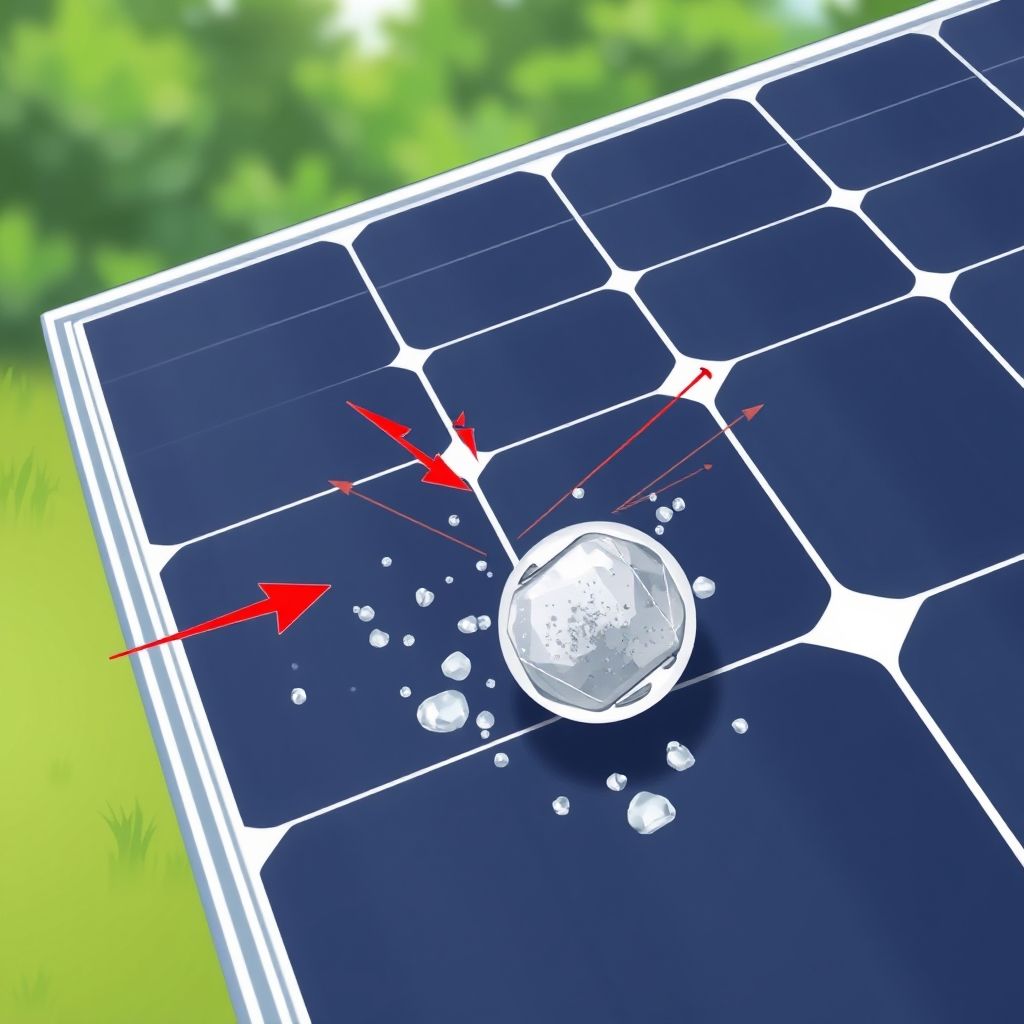
Iranian scientists have engineered a simulation framework to forecast the path of falling ice and evaluate the resulting harm to solar panels. This approach integrates variables including air velocity, airflow orientation, the aerodynamic characteristics of the hail, and the inclination of the modules.
Hasanpour highlighted that a key discovery was the substantial role that airflow orientation plays in determining the angle at which ice impacts the surfaces.
Methodology and Parameters
The study validated the framework by applying it to a 3 MW solar installation in Takestan, Iran, utilizing local meteorological data from 2004 through 2024. The computational scenarios modeled spherical hail particles with diameters between 1 cm and 10 cm. To encompass diverse atmospheric states, wind velocities were adjusted within a range of 1 m/s to 50 m/s, while every hailstone began its descent from a fixed altitude of 2,000 m.
Trajectory calculations employed the fourth-order Runge–Kutta method, a numerical strategy for resolving differential equations that estimates solutions via discrete, incremental steps.
Wind Dynamics and Impact Physics
- Armin Hasanpour, the corresponding author, observed that wind velocity by itself is insufficient to characterize impact behavior; rather, the interplay of wind direction, velocity, and panel orientation can drastically modify the impact angle and energy distribution.
- The simulations evaluated distinct wind conditions: 22.8 m/s originating from 350°, alongside 24 m/s coming from 200°, 350°, and 360°.
- Modifying the photovoltaic panel tilt from 25° to 30° shifts impact properties and the portion of kinetic energy directed perpendicular to the panel face.
- The damage assessment model employed a critical energy limit of 2 J to evaluate potential module failure.
- Hasanpour stressed that these findings highlight the necessity for rigorous consideration of aerodynamic assumptions in the creation of predictive models.
- This research was carried out by scientists from Shahrood University of Technology, Radsun Energy Pars, and Asoo Vision Pardaz.
Model Validation and Findings
Researchers evaluated simulations that utilized fixed drag coefficients alongside those incorporating values that fluctuate with the Reynolds number. When analyzing hailstones with diameters of 8 cm or greater, the fixed-coefficient technique yielded discrepancies of roughly 14% relative to the variable-coefficient technique.
These results appeared in Sustainable Energy Technologies and Assessments in a paper named "Numerical modeling and analysis of weather conditions effects on hail impact severity and damage to photovoltaic panels." Armin Hasanpour, listed as the corresponding author, emphasized that choosing panel orientation should not rely solely on energy yield; instead, regional hailstorm characteristics and associated damage hazards require inclusion in the decision-making process.
Hasanpour further suggested that these quantitative methods might eventually feed into photovoltaic hail-risk databases utilized by insurers. Additionally, the information could aid policymakers in evaluating climate-related threats and assist designers in selecting more suitable panel tilt angles tailored to specific local weather patterns.
Source: pv magazine. This article is an original Luminity report based on the linked source.